
Master the Future of Construction with Job-Oriented Civil CADD Training
The civil engineering industry is evolving rapidly with the adoption of advanced design technologies and digital construction practices. Today, companies expect engineers to possess practical software expertise along with strong technical knowledge. Traditional academic learning provides a solid engineering foundation, but employers increasingly seek candidates who can contribute to projects from the very beginning. This growing demand has made Job Oriented Civil CADD Training an essential step for students and professionals who want to build successful careers in the construction and infrastructure sector.
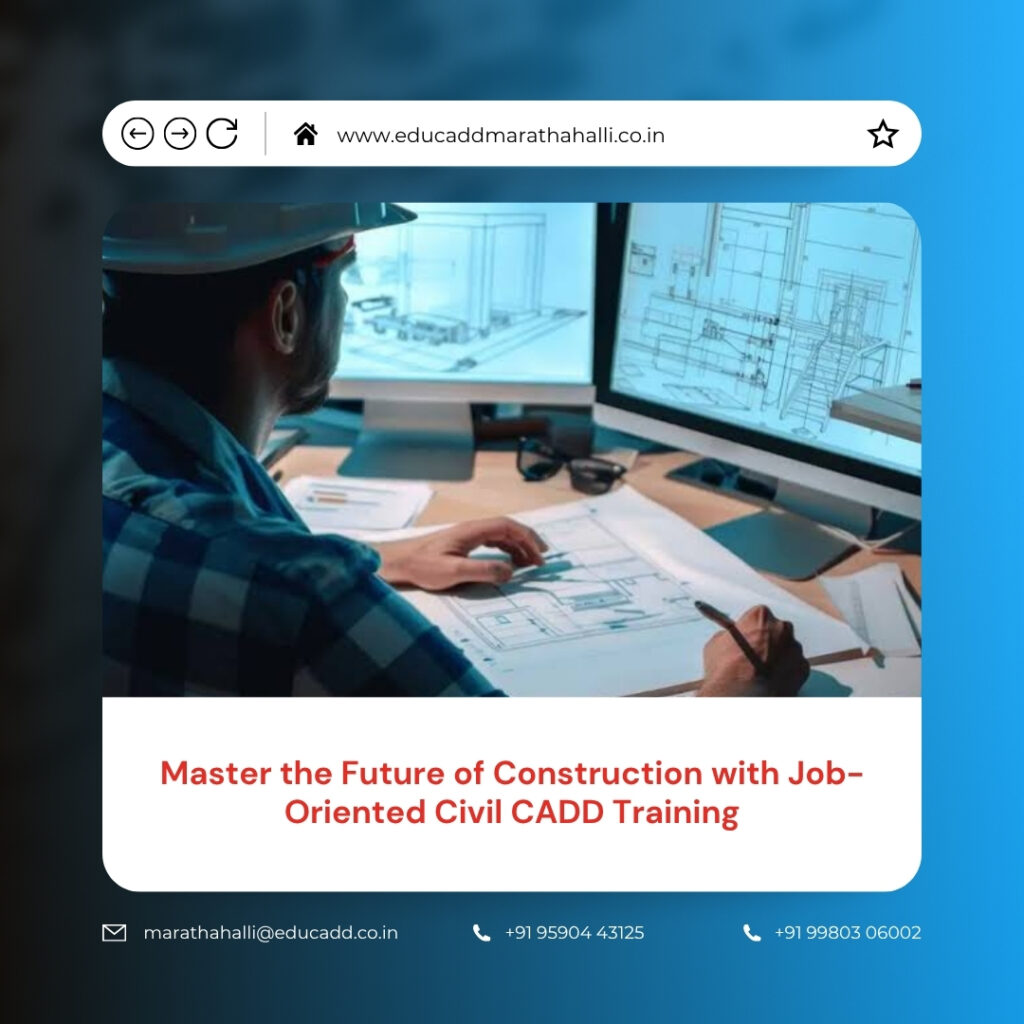
Job Oriented Civil CADD
A professionally designed Civil CADD course combines engineering principles with real-world software applications. Learners gain practical exposure to drafting, structural detailing, building planning, quantity estimation, and project documentation using industry-standard tools. More importantly, the training prepares students to solve real engineering challenges while improving productivity and design accuracy. Whether you have recently completed your education or wish to upgrade your technical skills, Job Oriented Civil CADD provides the knowledge and confidence needed to thrive in today’s competitive job market.
Why the Construction Industry Demands Civil CADD Professionals
The construction sector has undergone a remarkable transformation over the past decade. Digital design methods have replaced traditional manual drafting, making engineering projects faster, more accurate, and highly efficient. As construction projects become larger and more complex, companies require professionals who can prepare detailed engineering drawings while ensuring compliance with industry standards. This demand has significantly increased career opportunities for Civil CADD experts across residential, commercial, industrial, and infrastructure projects.
Organizations now depend on skilled professionals to produce precise layouts, structural drawings, and construction documentation that support smooth project execution. Engineers with practical drafting knowledge help reduce design errors, improve coordination among project teams, and accelerate project completion. As a result, candidates who complete Job Oriented Civil CADD enjoy better employment prospects because they possess practical skills that align with modern industry expectations.
Understanding What Job-Oriented Civil CADD Training Offers
Unlike conventional software courses, Job Oriented Civil CADD focuses on preparing students for actual workplace responsibilities. The curriculum blends engineering concepts with practical software applications, enabling learners to understand every stage of the design and construction process. Instead of memorizing commands, students develop the ability to create professional engineering drawings that meet industry standards.
The training introduces architectural drafting, structural detailing, site planning, reinforcement detailing, project documentation, and construction workflows. Learners also understand how engineering drawings communicate ideas among architects, engineers, contractors, and clients. This practical approach develops confidence while helping students build strong technical foundations that support long-term career growth.
Comprehensive Software Skills for Modern Engineering
One of the greatest advantages of Job-Oriented Civil CADD Training is the opportunity to learn multiple software applications that are widely used across the engineering industry. Each software program serves a unique purpose and contributes to different stages of construction planning and execution.
Students generally begin with AutoCAD to master technical drafting and engineering drawings. As their knowledge expands, they learn advanced applications such as Autodesk Revit for Building Information Modeling, Civil 3D for infrastructure planning, STAAD.Pro for structural analysis, and additional engineering tools that enhance design accuracy. By working with multiple platforms, learners become versatile professionals who can adapt to various project requirements and organizational standards.
Practical Project Experience That Builds Confidence
Employers value practical experience because it demonstrates a candidate’s ability to perform real engineering tasks. Therefore, Job-Oriented Civil CADD Training places strong emphasis on project-based learning. Students complete assignments that closely resemble the work carried out in professional engineering firms, allowing them to understand real construction challenges before entering the workforce.
Training projects often include residential building plans, commercial layouts, foundation drawings, structural reinforcement details, site development plans, road layouts, drainage systems, and utility planning. Every project strengthens drafting accuracy, technical understanding, and problem-solving abilities. Moreover, regular feedback from experienced instructors helps learners improve their performance while developing confidence to handle professional responsibilities independently.
Developing Industry-Ready Technical Competencies
Success in civil engineering requires more than software knowledge alone. Engineers must understand construction methods, technical standards, and effective project communication. Job-Oriented Civil CADD Training develops these essential competencies through continuous practice and practical exposure. Students learn how to interpret engineering drawings, prepare construction documentation, estimate quantities, coordinate design changes, and maintain drawing accuracy throughout project execution.
In addition to technical expertise, learners strengthen analytical thinking, attention to detail, time management, and communication skills. These qualities enable professionals to work efficiently within multidisciplinary project teams. Consequently, graduates become valuable contributors who can support architects, structural engineers, project managers, and construction companies with confidence and professionalism.
Building a Strong Foundation for a Successful Engineering Career
A rewarding engineering career begins with practical knowledge and continuous skill development. While academic education introduces the principles of civil engineering, practical training enables students to apply those principles in real construction projects. Job-Oriented Civil CADD Training bridges this important gap by combining technical concepts with industry-focused applications. Students learn how engineering drawings are prepared, reviewed, and implemented throughout different phases of construction. This practical understanding allows them to approach projects with confidence and accuracy. Furthermore, they become familiar with professional workflows followed by engineering consultants, contractors, and infrastructure companies. As their technical abilities improve, they develop greater confidence during interviews and perform effectively from the first day of employment.
Career Opportunities After Completing Job-Oriented Civil CADD Training
The demand for qualified Civil CADD professionals continues to increase because infrastructure development remains a priority across both public and private sectors. Large-scale construction projects require skilled engineers who can create detailed drawings, coordinate project documentation, and support design teams throughout the project lifecycle. After completing Job-Oriented Civil CADD Training, learners can explore opportunities in architectural firms, structural consulting companies, construction organizations, real estate developers, government departments, transportation projects, and engineering consultancies.
Career options include Civil CAD Engineer, CAD Draftsman, Structural Draftsman, BIM Modeler, Site Engineer, Quantity Surveyor, Planning Engineer, Design Engineer, Project Coordinator, and Construction Documentation Specialist. With practical experience and continuous learning, professionals can advance into senior engineering and project management positions while enjoying attractive salary growth.
The Importance of Real-Time Assignments and Portfolio Development
A strong portfolio often creates a positive impression during job interviews because it demonstrates practical capability rather than theoretical knowledge alone. Therefore, Job-Oriented Civil CADD Training encourages students to complete multiple real-world assignments that reflect current industry standards. Every drawing prepared during the course strengthens technical skills while helping learners understand professional drafting practices.
Students develop architectural floor plans, elevation drawings, sectional views, structural layouts, reinforcement details, foundation drawings, site plans, utility layouts, and quantity estimation sheets. These projects collectively form a professional portfolio that showcases design accuracy, creativity, and engineering knowledge. Recruiters appreciate candidates who can present completed project work because it reflects genuine practical experience. Consequently, portfolio development significantly improves employability and interview performance.
Why Employers Prefer Candidates with Practical Software Expertise
Today’s employers seek professionals who require minimal training after recruitment. Organizations prefer candidates who already understand industry software, construction documentation, and engineering standards. Job-Oriented Civil CADD Training prepares students to meet these expectations by emphasizing practical application instead of theoretical learning alone. Graduates become familiar with project coordination, drafting standards, drawing revisions, and documentation procedures that are commonly followed in professional workplaces.
Moreover, trained professionals adapt quickly to new projects because they already understand software workflows and engineering practices. This readiness saves valuable training time for employers while improving project efficiency. Companies recognize the value of candidates who can contribute immediately, making Civil CADD professionals highly desirable across the construction industry.
Staying Competitive in an Evolving Construction Industry
Technology continues to reshape the construction sector through digital engineering, Building Information Modeling, automation, and smart infrastructure development. As these innovations become more common, engineers must continuously upgrade their knowledge to remain competitive. Job-Oriented Civil CADD Training equips learners with the adaptability needed to embrace emerging technologies while maintaining strong engineering fundamentals.
Continuous learning enables professionals to work on advanced projects involving sustainable buildings, smart city developments, transportation networks, industrial facilities, and large commercial complexes. Engineers who regularly enhance their software expertise and technical knowledge remain valuable throughout their careers. This commitment to professional development opens opportunities for leadership positions, international projects, and specialized engineering roles.
Conclusion
Modern civil engineering demands professionals who combine technical knowledge with practical software expertise and industry awareness. Academic qualifications provide an excellent starting point, but practical skills determine long-term career success. Job Oriented Civil CADD Training empowers students, graduates, and working professionals with the confidence, technical competence, and real-world experience required to excel in today’s competitive engineering landscape.
By mastering industry-standard software, working on real-time projects, and developing professional drafting skills, learners become job-ready from the very beginning of their careers. They gain the ability to create accurate engineering drawings, improve project efficiency, and collaborate effectively with multidisciplinary teams. As infrastructure development continues to expand across the country and around the world, the demand for skilled Civil CADD professionals will only continue to grow. Choosing Job Oriented Civil CADD is more than enrolling in a course—it is a strategic investment in a future filled with career growth, professional recognition, and lasting success in the dynamic field of civil engineering.

