
Navisworks Clash Detection Training: The Smart Path to Error-Free BIM Coordination and Construction Success
The construction industry has undergone a remarkable transformation in recent years, driven by the adoption of Building Information Modeling (BIM) technologies. As projects become more complex and multidisciplinary teams collaborate on large-scale developments, the need for accurate coordination has never been greater. Architects, structural engineers, mechanical designers, electrical consultants, and plumbing specialists must work together seamlessly to ensure every component fits perfectly within a project. This is where Navisworks Clash Detection Training plays a critical role. However, without proper coordination, design conflicts can emerge, leading to delays, increased costs, and unnecessary rework during construction.
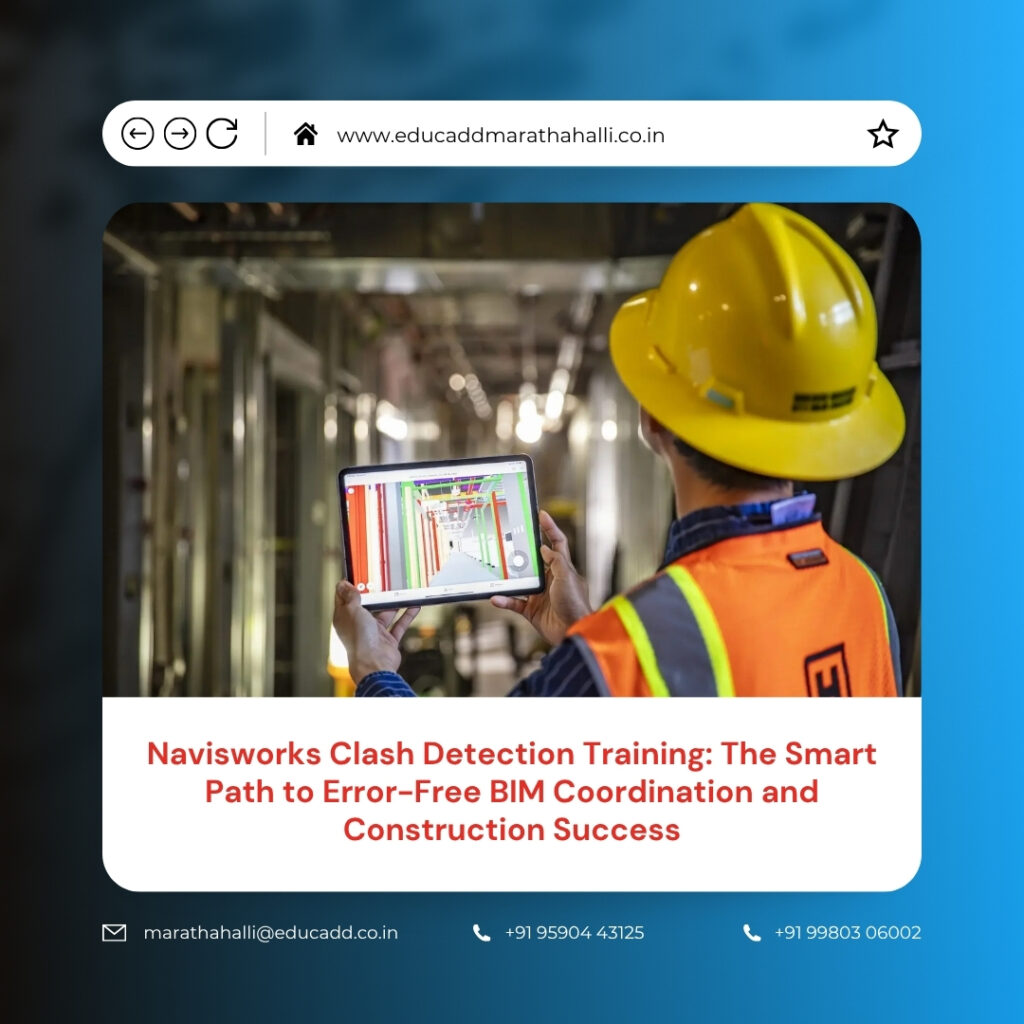
Navisworks Clash Detection Training
Navisworks is one of the most powerful BIM coordination tools used worldwide to identify and resolve design conflicts before construction begins. Through professional training, learners gain the skills required to detect clashes, coordinate multiple disciplines, and improve project efficiency. As organizations increasingly rely on BIM-driven workflows, professionals with Navisworks expertise have become highly sought after. This blog explores the significance of Navisworks Clash Detection Training, its practical applications, industry benefits, and the career opportunities it creates for aspiring BIM professionals.
Understanding the Importance of Navisworks in Modern Construction
Navisworks has established itself as a leading project review and coordination software within the Architecture, Engineering, and Construction industry. Unlike traditional design tools that focus on creating models, Navisworks specializes in integrating models from multiple disciplines into a single collaborative environment. This capability allows project teams to visualize the entire project before construction activities begin.
The software supports various file formats, making it easier for teams using different design platforms to work together effectively. By bringing all project components into one model, Navisworks provides a comprehensive overview of how systems interact within a building. Consequently, project stakeholders can identify conflicts, assess risks, and make informed decisions at an early stage. This proactive approach helps organizations avoid costly construction issues and achieve better project outcomes.
Why Clash Detection Has Become Essential for BIM Projects
Construction projects contain thousands of interconnected elements that must function together without interference. Even minor design conflicts can create significant challenges during project execution. For instance, an HVAC duct passing through a structural beam or a plumbing line conflicting with electrical systems can cause substantial delays and additional expenses.
Clash detection addresses these challenges by identifying conflicts before construction begins. Instead of discovering problems on-site, project teams can resolve issues during the design phase when modifications are faster and less expensive. This capability significantly improves project efficiency and minimizes costly rework.
Furthermore, clash detection enhances communication among project participants. Everyone works with accurate and coordinated information, reducing misunderstandings and improving decision-making throughout the project lifecycle. As BIM adoption continues to expand globally, clash detection has become a standard requirement for successful project delivery.
Growing Industry Demand for Navisworks Clash Detection Professionals
The increasing adoption of BIM methodologies has created strong demand for professionals skilled in Navisworks clash detection. Construction companies, engineering consultants, infrastructure developers, and project management firms actively seek individuals who can coordinate complex projects and identify design conflicts before construction begins.
Governments around the world are also encouraging BIM implementation for public infrastructure projects. As a result, organizations require trained professionals who understand BIM coordination workflows and advanced clash detection techniques. This trend has made Navisworks expertise one of the most valuable skills in the construction technology sector.
Professionals who complete specialized training often enjoy improved career prospects because employers recognize the direct value they bring to project success. Their ability to reduce risks, improve coordination, and support efficient project delivery makes them essential members of modern construction teams.
Learning the Fundamentals of Navisworks Software
A comprehensive Navisworks training program begins with a strong foundation in software navigation and project review techniques. Students learn how to explore large BIM models, organize project data, create viewpoints, and manage model visibility settings.
These foundational skills are crucial because effective clash detection depends on understanding the overall project structure. Trainees also learn how to manipulate models, create section views, and navigate through complex project environments with confidence.
In addition, training introduces participants to model review processes that help stakeholders evaluate project designs from different perspectives. By mastering these basics, learners establish the knowledge needed to perform advanced coordination and clash detection activities efficiently.
Mastering Model Aggregation for Better Coordination
One of the most valuable capabilities of Navisworks is model aggregation. Modern construction projects involve separate models created by architectural, structural, mechanical, electrical, and plumbing teams. Reviewing these models independently often makes it difficult to identify conflicts that occur between systems.
Navisworks allows users to combine all discipline-specific models into a unified project environment. This aggregated model provides a complete view of the project and enables coordinators to analyze how different systems interact with one another.
When project teams work with integrated models, they gain a better understanding of spatial relationships and design dependencies. Consequently, coordination becomes more efficient, communication improves, and project risks decrease significantly. Model aggregation serves as the foundation for successful BIM coordination and effective clash detection workflows.
Developing Expertise in Clash Detection Workflows
The core objective of Navisworks training is to develop expertise in clash detection workflows. During this stage, students learn how to create clash tests between different building systems and analyze potential conflicts.
The software automatically identifies areas where components overlap or violate predefined clearance requirements. Once clashes are detected, users can review each issue, determine its severity, and recommend appropriate corrective actions.
Key areas covered during clash detection training include:
- Creating and managing clash tests between disciplines.
- Reviewing, grouping, and categorizing detected clashes.
Through hands-on practice, trainees gain the confidence needed to handle real-world coordination challenges. This practical experience prepares them to contribute effectively to BIM projects immediately after completing their training.
Understanding Different Types of Construction Clashes
An important aspect of Navisworks training involves understanding the various categories of clashes commonly encountered in construction projects. Each type requires a different approach to resolution and project coordination.
Hard clashes occur when two physical components occupy the same space. Examples include ducts passing through beams or pipes intersecting structural columns. These conflicts require immediate correction because construction cannot proceed without resolving them.
Soft clashes involve clearance requirements rather than direct physical interference. Equipment maintenance zones, safety clearances, and accessibility requirements often generate soft clashes. Workflow clashes, on the other hand, relate to scheduling conflicts and construction sequencing issues. Understanding these distinctions allows professionals to prioritize issues and implement effective solutions throughout the project lifecycle.
Improving Visualization and Project Understanding
Visualization is one of the strongest features of Navisworks. The software enables users to view projects in a realistic three-dimensional environment, making it easier to understand design intent and identify potential challenges.
Advanced visualization tools allow project teams to create walkthroughs, animations, viewpoints, and section cuts. These capabilities help stakeholders explore every aspect of a project before construction begins. Consequently, design issues become easier to identify and communicate.
Enhanced visualization also improves client presentations. Non-technical stakeholders often struggle to interpret traditional drawings and technical documentation. Three-dimensional project views simplify communication and ensure that everyone involved understands the project requirements clearly.
Leveraging 4D Construction Simulation for Better Planning
In addition to clash detection, Navisworks provides powerful 4D simulation capabilities that connect project schedules with BIM models. This integration enables construction teams to visualize project progress over time and evaluate construction sequences before work begins on-site.
Through training, students learn how to link scheduling data to model components and create realistic construction simulations. These simulations reveal potential workflow conflicts, resource allocation challenges, and sequencing issues that could affect project timelines.
Benefits of 4D simulation include:
- Improved construction planning and scheduling accuracy.
- Better resource management and project monitoring.
By understanding project timelines visually, teams can make proactive decisions that improve efficiency and reduce delays throughout the construction process.
Strengthening Collaboration Among Project Stakeholders
Successful BIM projects rely heavily on collaboration among multiple stakeholders. Architects, engineers, contractors, consultants, and clients must communicate effectively to achieve project goals. Navisworks facilitates this collaboration by providing a centralized platform for project review and coordination.
The software enables teams to share models, review clashes, assign responsibilities, and track issue resolution progress. This transparency ensures that everyone has access to the same project information and can contribute to decision-making processes.
Improved collaboration reduces communication gaps and minimizes misunderstandings that often lead to project delays. As a result, organizations can maintain smoother workflows and achieve higher levels of project efficiency. Training professionals to use these collaboration tools effectively significantly enhances overall project performance.
Practical Applications Across Multiple Industries
Navisworks clash detection is widely used across numerous sectors within the construction and infrastructure industries. Commercial buildings, residential developments, healthcare facilities, industrial plants, airports, and transportation projects all benefit from BIM coordination and clash detection processes.
In hospital projects, for example, complex mechanical and electrical systems require precise coordination to meet operational requirements. Industrial facilities depend on accurate coordination between piping systems, equipment layouts, and structural frameworks. Similarly, large infrastructure projects use Navisworks to manage extensive multidisciplinary designs efficiently.
As project complexity continues to increase, the ability to identify and resolve conflicts early becomes even more valuable. Therefore, Navisworks skills remain relevant across virtually every segment of the construction industry.
Career Opportunities After Completing Navisworks Training
Professionals who master Navisworks clash detection enjoy access to a wide range of career opportunities within the BIM ecosystem. Organizations actively seek skilled individuals capable of managing project coordination and resolving design conflicts efficiently.
Popular career paths include BIM Coordinator, BIM Engineer, BIM Specialist, BIM Modeler, Design Coordinator, Project Engineer, and BIM Manager. These roles offer strong growth potential as BIM adoption expands across global markets.
Moreover, professionals with Navisworks expertise often command competitive salaries because their skills directly contribute to project success. Their ability to prevent costly errors and improve project efficiency makes them valuable assets for employers across the construction industry.
Key Competencies Gained Through Professional Training
Professional Navisworks training develops a combination of technical knowledge and practical problem-solving abilities. Students learn how to coordinate multidisciplinary models, manage clash detection workflows, generate reports, and support project teams during coordination meetings.
In addition to technical expertise, trainees develop analytical thinking skills that help them evaluate complex design scenarios. They also improve communication abilities that are essential for presenting clash reports and coordinating with stakeholders.
These competencies enhance professional confidence and prepare individuals for leadership roles within BIM projects. As technology continues to reshape the construction industry, these skills become increasingly valuable for long-term career growth and success.
The Long-Term Value of Navisworks Training for Organizations
Organizations that invest in Navisworks-trained professionals gain significant advantages throughout the project lifecycle. Early clash detection reduces construction errors, minimizes rework, and lowers project costs. These improvements directly contribute to higher profitability and more successful project outcomes.
Furthermore, coordinated BIM models improve planning accuracy and streamline communication among project teams. This efficiency leads to faster project delivery, better resource utilization, and improved client satisfaction. Companies can also strengthen their competitive position by consistently delivering high-quality projects on time and within budget.
As BIM standards continue to evolve, organizations increasingly recognize the importance of skilled coordination professionals. Investing in Navisworks training helps businesses remain competitive while supporting long-term operational excellence.
Conclusion
The future of construction depends heavily on digital collaboration, intelligent planning, and efficient project coordination. Navisworks has emerged as one of the most effective tools for achieving these objectives through advanced clash detection and BIM coordination capabilities. By identifying conflicts before construction begins, the software helps organizations reduce risks, improve productivity, and deliver projects with greater confidence.
Navisworks Clash Detection Training equips professionals with the expertise needed to manage complex building models, coordinate multiple disciplines, and support successful project execution. From model aggregation and clash analysis to 4D simulation and stakeholder collaboration, the skills gained through training provide significant value across every phase of construction. As BIM adoption continues to accelerate worldwide, professionals who invest in Navisworks training position themselves for rewarding careers while helping organizations achieve superior project outcomes in an increasingly competitive industry.

