
From Concept to Asset Management: A Complete BIM LOD 100 to 500 Training Journey for Future Construction Professionals
The architecture, engineering, and construction industry is experiencing a major shift toward digital project delivery. Traditional methods of designing and managing buildings are no longer sufficient to meet the growing demands for accuracy, speed, collaboration, and cost efficiency. Building Information Modeling (BIM) has emerged as a transformative technology that enables project teams to create intelligent digital representations of buildings and infrastructure throughout their lifecycle. However, the true value of BIM can only be realized when professionals understand how information develops and matures within a BIM model. This is where BIM LOD Training Program become essential.
BIM LOD Training Program
A BIM LOD Training Program provides comprehensive knowledge of how building information evolves from early conceptual planning to facility operation and maintenance. Each LOD stage serves a unique purpose and delivers increasing levels of geometric accuracy and information reliability. Through structured training, participants gain the skills required to create, coordinate, analyze, and manage BIM models that support every phase of a construction project. Whether you are an architect, civil engineer, structural designer, MEP professional, contractor, or project manager, mastering BIM LOD standards can significantly improve your career prospects and technical expertise in today’s digital construction environment.
Understanding BIM LOD and Its Role in Modern Construction
Before exploring individual development levels, it is important to understand the purpose behind BIM LOD standards. The Level of Development framework establishes a clear definition of the amount of information and detail that a BIM element contains at different project stages. It helps project stakeholders communicate expectations and ensures consistency throughout the project lifecycle.
The BIM LOD 100 to 500 Training Program introduces participants to industry-recognized standards that define model progression. These standards eliminate confusion among designers, engineers, contractors, and owners by clearly outlining how much information can be relied upon at each stage. When everyone understands the intended use of model data, collaboration becomes more efficient, project risks decrease, and decision-making improves significantly. As construction projects become increasingly complex, LOD standards provide the structure needed to maintain clarity and accountability.
BIM LOD 100: Building the Foundation Through Conceptual Modeling
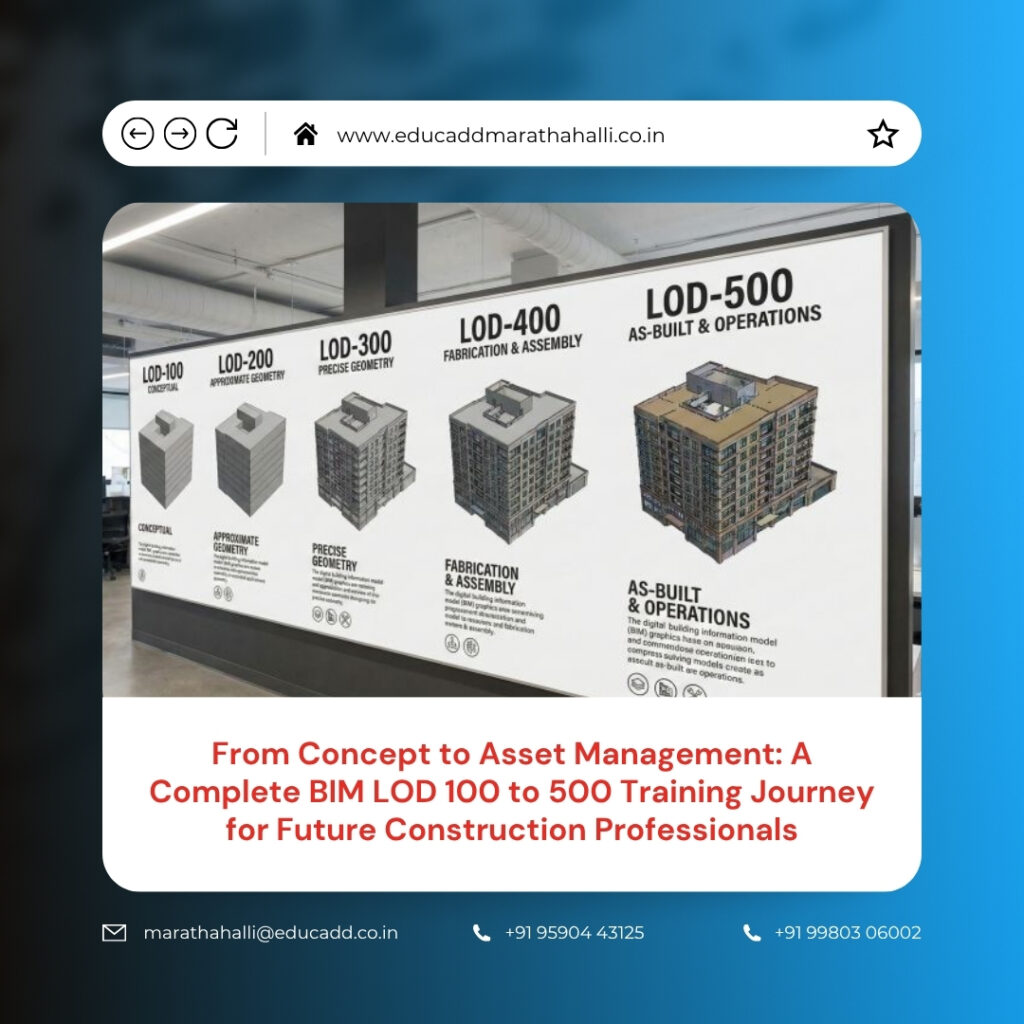
LOD 100 represents the starting point of BIM development and focuses primarily on conceptual design. At this stage, models contain basic representations that communicate project intent rather than detailed construction information. Designers use these models to evaluate site conditions, building massing, orientation, and preliminary space planning.
Within a BIM LOD 100 to 500 Training Program, learners discover how conceptual BIM models support early project discussions and feasibility assessments. They learn methods for developing mass models, conducting preliminary analyses, and presenting design concepts to clients and stakeholders. Since project requirements are still evolving, flexibility remains a key characteristic of LOD 100 modeling. Despite its simplicity, this level provides valuable insights that influence future design decisions and establish the groundwork for project success.
BIM LOD 200: Transforming Concepts into Preliminary Design Solutions
As project planning progresses, models evolve into LOD 200, where elements begin to represent actual building systems with approximate dimensions and locations. This stage allows project teams to refine concepts while maintaining room for future modifications. Designers start developing more realistic representations of architectural, structural, and MEP components.
The BIM LOD 100 to 500 Training Program emphasizes the importance of transitioning smoothly from conceptual planning to schematic design. Participants gain practical knowledge in creating preliminary building models that support budgeting, design validation, and early-stage coordination activities. LOD 200 models provide stakeholders with a clearer understanding of project scope and performance expectations.
Important learning outcomes include:
- Developing preliminary architectural, structural, and MEP system layouts.
- Generating early project estimates using BIM-based quantities and schedules.
By mastering these techniques, professionals can contribute to more informed planning and better project forecasting.
BIM LOD 300: Creating Accurate Models for Design Development
LOD 300 marks the stage where BIM models become highly detailed and dependable for design documentation. Building elements contain accurate dimensions, locations, orientations, and quantities that closely represent the intended final design. This level enables project teams to produce coordinated construction documents and perform detailed project analysis.
During the BIM LOD 100 to 500 Training Program, participants learn advanced modeling techniques that improve design accuracy and consistency. They gain experience creating comprehensive models that support architectural detailing, structural coordination, and MEP integration. Additionally, they understand how to extract drawings, schedules, and quantity reports directly from BIM models.
The ability to produce reliable LOD 300 models is highly valuable because it minimizes design discrepancies and supports smoother project execution. Consequently, organizations benefit from reduced errors, fewer revisions, and improved productivity throughout the design phase.
BIM LOD 350: Improving Coordination Across Multiple Disciplines
Construction projects involve numerous systems that must function together seamlessly. LOD 350 addresses this requirement by incorporating interfaces and interactions between building components. At this level, BIM models not only represent individual elements but also demonstrate how systems connect and influence one another.
The BIM LOD 100 to 500 Training Program provides extensive instruction on interdisciplinary coordination and collaboration strategies. Participants learn how to identify system interactions, evaluate spatial relationships, and resolve coordination challenges before construction begins. This proactive approach reduces costly field modifications and improves project efficiency.
Professionals trained in LOD 350 workflows become valuable contributors to project teams because they can facilitate communication among architects, engineers, contractors, and consultants while maintaining design integrity throughout the coordination process.
BIM LOD 400: Supporting Fabrication and Construction Activities
LOD 400 introduces a level of detail specifically intended for construction and fabrication purposes. Models developed at this stage contain precise dimensions, assembly details, fabrication information, and installation requirements. Contractors and manufacturers rely on these models to support production and field execution.
Within the BIM LOD 100 to 500 Training Program, learners explore methods for creating constructible BIM models that align with real-world construction processes. They develop skills related to fabrication modeling, prefabrication workflows, and installation planning. As the construction industry increasingly adopts modular and off-site manufacturing techniques, LOD 400 expertise becomes even more valuable.
Participants also gain insight into how detailed BIM models improve scheduling accuracy, material management, and resource allocation. These capabilities contribute directly to faster project delivery and improved construction quality.
BIM LOD 500: Delivering Value Beyond Project Completion
Many professionals mistakenly assume that BIM ends when construction finishes. In reality, some of the greatest benefits of BIM emerge after project handover. LOD 500 represents the final stage of model development and captures verified as-built conditions. These models serve as digital records of completed facilities and support long-term operations.
The BIM LOD 100 to 500 Training Program teaches participants how to create accurate as-built models using field verification data and updated project information. Facility managers, building owners, and maintenance teams use these models to manage assets, schedule maintenance activities, and optimize building performance.
Because operational costs often exceed construction costs over a facility’s lifespan, LOD 500 models provide tremendous value by supporting informed asset management and reducing maintenance inefficiencies.
Managing BIM Information Throughout the Project Lifecycle
One of the most important concepts taught in a BIM LOD 100 to 500 Training Program is information management. BIM is much more than a three-dimensional model. It serves as a centralized database containing valuable project information that supports decision-making at every stage.
Participants learn how to organize data, maintain model integrity, and establish effective information management procedures. They gain practical knowledge in parameter management, naming conventions, version control, and document coordination. These practices ensure that project teams can access accurate information whenever needed.
Strong information management skills help organizations maintain consistency, improve communication, and maximize the value of BIM throughout the project lifecycle.
Clash Detection and Coordination Excellence Through BIM
One of BIM’s most powerful capabilities is its ability to identify conflicts before construction begins. Clash detection allows project teams to locate and resolve issues between architectural, structural, and MEP systems during the design phase rather than on-site.
The BIM LOD 100 to 500 Training Program provides detailed training in coordination workflows and clash management techniques. Participants learn how to conduct model reviews, perform clash analysis, and collaborate with stakeholders to implement effective solutions.
Key benefits of clash detection include:
- Reduced construction delays caused by unforeseen conflicts.
- Lower project costs through proactive issue resolution.
These advantages make BIM coordination an essential skill for professionals seeking to improve project outcomes and enhance team collaboration.
Software Skills Developed During BIM LOD Training Program
Successful BIM implementation depends on proficiency with industry-standard software tools. Therefore, a BIM LOD 100 to 500 Training Program typically includes practical instruction using leading BIM platforms utilized across architecture, engineering, and construction sectors.
Participants learn how to create intelligent models, generate documentation, conduct coordination reviews, and manage project information within professional software environments. Hands-on exercises help reinforce theoretical concepts while preparing learners for real-world project requirements.
Software proficiency not only enhances technical capabilities but also increases employability. Employers consistently seek professionals who can effectively apply BIM tools to improve project delivery and support digital transformation initiatives.
Career Growth Opportunities in the BIM Industry
The global demand for BIM professionals continues to rise as organizations invest in digital construction technologies. Governments, developers, contractors, and consulting firms increasingly require BIM expertise to meet project requirements and industry standards.
Completing a BIM LOD 100 to 500 Training Program opens doors to a wide range of career opportunities. Professionals can pursue roles such as BIM Modeler, BIM Coordinator, BIM Engineer, BIM Manager, Design Manager, Construction Technology Specialist, Project Information Manager, and Facility Management Consultant.
As organizations prioritize efficiency, sustainability, and digital innovation, professionals with comprehensive BIM knowledge often enjoy stronger career prospects, competitive salaries, and greater opportunities for leadership positions.
The Business Impact of BIM LOD Expertise
Organizations that employ BIM-trained professionals often experience measurable improvements in project performance. Accurate models support better planning, enhanced coordination, reduced rework, and improved communication among stakeholders. These benefits translate directly into financial savings and operational efficiency.
The BIM LOD 100 to 500 Training Program prepares participants to contribute strategically to project success. By understanding how BIM information evolves across different development stages, professionals can align project deliverables with client expectations and business objectives. This capability strengthens organizational competitiveness while supporting consistent project outcomes.
As digital construction becomes the industry standard, companies that embrace BIM expertise position themselves for long-term growth and innovation.
The Future of BIM and Digital Construction Technologies
The future of construction extends beyond traditional BIM workflows. Emerging technologies such as digital twins, artificial intelligence, machine learning, cloud collaboration platforms, augmented reality, virtual reality, and smart building systems are transforming how facilities are designed, built, and operated.
A BIM LOD 100 to 500 Training Program provides the foundational knowledge necessary to adapt to these innovations. Understanding how information develops across BIM models enables professionals to integrate advanced technologies more effectively and support data-driven decision-making.
As the industry continues evolving, BIM professionals with strong LOD expertise will play a critical role in shaping the future of digital construction. Their ability to manage information, coordinate teams, and deliver intelligent models will remain essential in an increasingly connected and technology-driven built environment.
Conclusion
A BIM LOD Training Program offers a complete roadmap for understanding and applying Building Information Modeling throughout the entire construction lifecycle. From early conceptual planning and design development to fabrication, construction, facility operations, and asset management, each LOD stage contributes unique value to project success. Professionals who master these development levels gain the ability to create reliable models, improve coordination, enhance communication, and support informed decision-making across multidisciplinary teams.
As BIM adoption accelerates worldwide, organizations continue seeking professionals who can manage projects using structured and information-rich BIM workflows. Investing in BIM LOD training not only strengthens technical expertise but also prepares individuals for long-term career growth in the rapidly evolving construction industry. By mastering BIM from LOD 100 to LOD 500, professionals position themselves at the forefront of digital construction and become key contributors to smarter, more efficient, and more sustainable project delivery.

