
Build the Future of Design: Why a Revit Architecture Course with Certification Is Your Gateway to BIM Excellence
A Revit Architecture Certification Course offers aspiring professionals the opportunity to gain practical expertise in one of the most powerful architectural design platforms available. The course not only teaches software operation but also develops an understanding of modern BIM processes that are essential in today’s construction environment. Whether you are a student preparing for a successful career, an architect looking to upgrade your skills, or a working professional seeking better opportunities, certified Revit training can help you stay ahead of industry trends. This article explores how a Revit Architecture Certification Course can transform your career and prepare you for the future of architectural design.
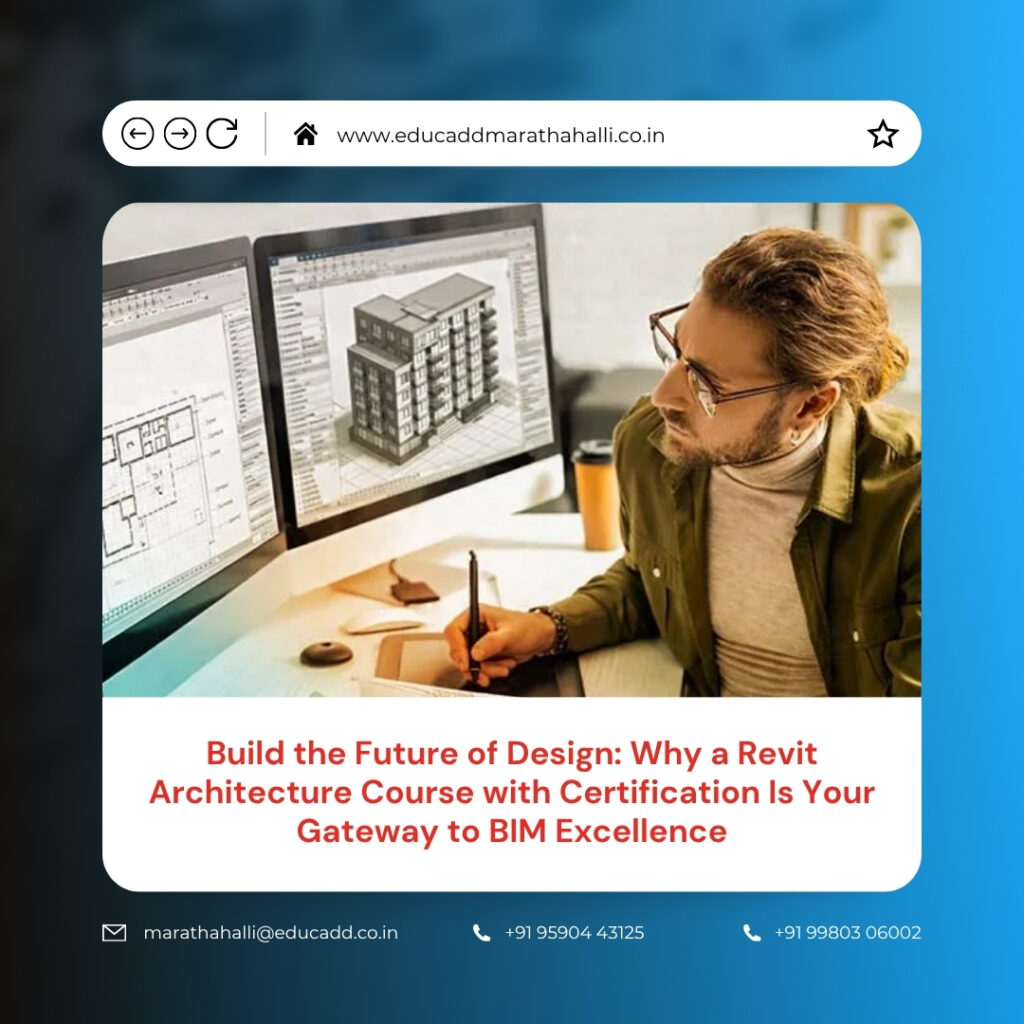
Revit Architecture Certification Course
The architecture and construction industry has entered a new era where digital technology drives every stage of building design and project execution. Traditional drafting methods are rapidly being replaced by intelligent Building Information Modeling (BIM) systems that enhance collaboration, improve accuracy, and streamline project delivery. Among the many BIM tools available today, Autodesk Revit has become the preferred choice for architects, designers, and construction professionals worldwide. As organizations increasingly adopt BIM-based workflows, the demand for skilled Revit professionals continues to grow across local and international markets.
Understanding the Growing Role of Revit in Architecture
The architecture industry constantly evolves to meet increasing demands for efficiency, sustainability, and precision. Modern projects require teams to coordinate large amounts of information while maintaining strict quality standards and deadlines. Revit addresses these challenges by providing a comprehensive BIM platform that allows professionals to create intelligent 3D building models.
Unlike conventional drafting software, Revit connects all project information within a single model. Every modification automatically updates related drawings, schedules, and views. This interconnected workflow significantly reduces manual work and minimizes costly errors. As a result, many architectural firms and construction companies rely on Revit to manage complex projects more effectively. Learning Revit through a structured certification program enables professionals to contribute immediately to these modern project environments and remain relevant in an increasingly technology-driven industry.
What Makes a Revit Architecture Certification Course Valuable?
A Revit Architecture Certification Course offers much more than basic software training. It combines theoretical BIM knowledge with practical project-based learning to create industry-ready professionals. Participants learn how to develop complete architectural models, generate construction documentation, and collaborate within multidisciplinary project teams.
Certification adds substantial value because it serves as proof of competence. Employers often seek candidates who possess recognized credentials because certification demonstrates commitment, technical proficiency, and professional development. Additionally, certified professionals frequently gain access to better career opportunities and higher earning potential. Since the industry continues to prioritize digital workflows, obtaining certification can significantly strengthen a candidate’s profile and increase confidence when applying for architecture and BIM-related positions.
Learning the Fundamentals of Architectural Modeling
Architectural modeling is one of the most important aspects of Revit training. During the course, students begin by learning the software interface, project setup procedures, and navigation tools. These foundational skills create a strong platform for advanced learning later in the program.
As training progresses, learners develop building elements such as walls, floors, roofs, ceilings, windows, doors, and staircases. Every component contains intelligent data that interacts with the overall project model. This capability allows students to understand how changes affect the entire building design. Practical exercises help learners become comfortable with modeling workflows while developing accuracy and efficiency. By mastering architectural modeling techniques, students gain the ability to create professional-quality building designs suitable for real-world applications.
Exploring the Core Principles of Building Information Modeling
Building Information Modeling is much more than creating attractive 3D designs. BIM represents a collaborative process that integrates design, documentation, analysis, and project management into a unified system. Therefore, a high-quality Revit Architecture Course with Certification places significant emphasis on BIM principles.
Students learn how BIM improves communication among architects, engineers, contractors, and project stakeholders. They discover how digital models can reduce design conflicts, improve resource planning, and support better decision-making throughout the project lifecycle. Understanding BIM methodologies helps professionals adapt to industry expectations and participate effectively in modern construction projects. As BIM adoption expands worldwide, professionals with strong BIM knowledge continue to enjoy increasing demand across multiple sectors of the built environment.
Developing Advanced Construction Documentation Skills
Construction documentation remains a critical responsibility for architectural professionals. Accurate drawings and detailed project information ensure that designs are executed correctly during construction. Revit simplifies this process by automatically generating documentation from the building model.
Throughout the training program, students learn how to create floor plans, elevations, sections, detail drawings, schedules, and sheet layouts. They also gain experience in annotation techniques and industry-standard documentation practices. Because all drawings remain connected to the central model, updates occur automatically whenever modifications are made. This approach improves productivity while reducing inconsistencies. By developing strong documentation skills, learners become capable of producing professional deliverables that meet the expectations of employers and clients alike.
Understanding Revit Families and Custom Components
One of the most powerful features within Revit is its family creation functionality. Families serve as reusable building components that contain customizable parameters and intelligent behavior. These elements play a vital role in architectural design and project standardization.
A Revit Architecture Certification Course teaches students how to create, edit, and manage families according to project requirements. Learners develop custom furniture, fixtures, doors, windows, and other specialized components that improve project flexibility. Family creation skills enable professionals to produce tailored solutions instead of relying solely on preloaded content. Consequently, employers highly value individuals who can create efficient BIM libraries and support project-specific design requirements. This expertise contributes significantly to overall project productivity and quality.
Enhancing Design Presentation Through Visualization
Architectural projects often require clear communication of design concepts to clients, investors, and stakeholders. Visualization tools help transform technical information into compelling presentations that support decision-making. Revit includes several features that enable users to produce realistic visual representations of their designs.
Students learn material application, lighting configuration, camera positioning, walkthrough generation, and rendering techniques. These capabilities allow designers to present projects with greater clarity and professionalism. High-quality visualizations improve client understanding and facilitate approval processes. Moreover, visualization skills increase a professional’s versatility and value within architectural teams. As presentation standards continue to rise across the industry, expertise in architectural visualization becomes an increasingly important career asset.
Practical Project Experience and Industry Exposure
One of the major advantages of enrolling in a professional Revit training program is the opportunity to work on practical projects. Classroom theory alone cannot fully prepare learners for industry challenges. Therefore, reputable training institutes emphasize hands-on exercises that replicate real-world project conditions.
Students often complete residential, commercial, institutional, and mixed-use building projects throughout their training. These assignments help them apply theoretical concepts while developing problem-solving abilities. Practical exposure also improves confidence and strengthens technical competence. By the time learners complete their certification program, they possess a portfolio of work that demonstrates their capabilities to potential employers. This practical experience often provides a competitive advantage during job interviews and recruitment processes.
Why Certification Matters in Today’s Competitive Job Market
The modern job market has become increasingly competitive, particularly within architecture and construction industries. Employers seek professionals who possess both technical knowledge and verified credentials. Certification serves as a trusted indicator of skill and competency.
Several benefits make certification valuable:
- It validates practical Revit and BIM expertise.
- It improves professional credibility during recruitment.
Certified candidates often stand out among applicants who lack formal recognition of their skills. Employers appreciate the assurance that certification provides regarding a candidate’s technical capabilities. Furthermore, certification demonstrates dedication to continuous learning and professional growth. These qualities make certified professionals attractive additions to design and construction teams.
Career Paths Available After Completing the Course
A Revit Architecture Course with Certification opens doors to numerous career opportunities across the architecture, engineering, and construction sectors. Organizations increasingly require BIM-trained professionals to support digital project delivery processes.
Graduates may pursue positions such as BIM Modeler, Architectural Designer, Revit Technician, BIM Coordinator, CAD Specialist, Design Consultant, and Project Documentation Expert. In addition, opportunities exist within construction management firms, engineering consultancies, infrastructure companies, and real estate development organizations. As BIM adoption continues to expand internationally, certified professionals can also explore global employment opportunities. This wide range of career options makes Revit training a valuable investment for long-term professional development.
How Revit Skills Support Long-Term Professional Growth
Learning Revit provides benefits that extend far beyond entry-level employment. As professionals gain experience, they can progress into senior technical and management roles within BIM environments. Revit expertise often serves as the foundation for broader specialization in digital construction technologies.
Professionals who begin as BIM modelers frequently advance to coordinator, manager, consultant, or BIM leadership positions. Their understanding of digital workflows enables them to oversee multidisciplinary project teams and implement advanced BIM strategies. Additionally, Revit integrates with several other technologies used in modern construction. Therefore, mastering Revit creates opportunities to expand into related fields while maintaining strong career growth potential over time.
Choosing the Best Institute for Revit Training
Selecting the right training institute plays a significant role in determining learning outcomes. A well-structured course should combine experienced instructors, updated curriculum content, practical assignments, and certification support. Prospective students should carefully evaluate available options before making a decision.
Important factors to consider include:
- Industry-experienced trainers and hands-on project exposure.
- Placement assistance and career support services.
Institutes that focus on practical learning generally produce graduates who adapt more quickly to workplace demands. Additionally, access to modern lab facilities and industry-relevant case studies enhances the overall learning experience. Taking time to select a quality training provider ensures better educational value and stronger career preparation.
The Future of BIM and Revit Technology
The construction industry is undergoing a digital transformation that continues to accelerate every year. Governments, private organizations, and multinational corporations increasingly require BIM implementation for large-scale projects. As a result, the importance of Revit continues to grow across global markets.
Emerging technologies such as cloud collaboration, artificial intelligence, digital twins, augmented reality, and virtual reality are becoming closely connected with BIM workflows. Revit serves as a critical component within these evolving technological ecosystems. Professionals who develop expertise today position themselves for future opportunities in advanced design and construction environments. Consequently, investing in a Revit Architecture Course with Certification represents a forward-thinking career decision that aligns with long-term industry trends.
Building a Strong Professional Portfolio Through Revit Training
A strong portfolio often determines whether a candidate secures interviews and employment opportunities. Employers want evidence of practical capability, not just theoretical knowledge. Revit training helps students create detailed project models and professional documentation that can be showcased during recruitment.
Portfolio development allows learners to demonstrate their understanding of BIM workflows, architectural design principles, and technical execution. Well-presented projects highlight problem-solving abilities, attention to detail, and software proficiency. Furthermore, portfolio projects provide talking points during interviews and help candidates communicate their strengths effectively. By completing a Revit Architecture Course with Certification, learners build both technical skills and a professional portfolio that supports career advancement.
Conclusion
The architecture and construction industries increasingly rely on BIM technology to improve efficiency, collaboration, and project outcomes. As one of the leading BIM platforms in the world, Revit has become an essential tool for professionals seeking success in modern design and construction environments. A Revit Architecture Certification Course provides comprehensive training in architectural modeling, BIM workflows, documentation, visualization, and project collaboration.
Beyond technical learning, certification validates expertise, enhances employability, and creates pathways to rewarding career opportunities. From students entering the workforce to experienced professionals pursuing career advancement, Revit training offers substantial benefits that extend across the entire construction ecosystem. As BIM adoption continues to expand globally, professionals with certified Revit skills will remain in high demand. Investing in a Revit Architecture Course with Certification today can help you build a stronger future, achieve professional growth, and become a valuable contributor to the next generation of architectural innovation.

