
The Future Runs on Data: Essential Big Data Technologies Every IT Professional Should Learn
Technology is evolving at an incredible pace, and data has become the driving force behind every major innovation. From online shopping platforms and healthcare systems to banking applications and social media networks, organizations now rely heavily on data to improve services and make faster decisions. Every click, search, transaction, and interaction creates valuable information that businesses use to understand customer behavior and market trends. Because of this rapid growth in digital information, Big Data Technologies Future have become one of the most important areas in the IT industry.
Modern organizations no longer depend only on traditional databases. Instead, they require advanced systems that can process large volumes of structured and unstructured data in real time. Companies want skilled professionals who can manage data efficiently, build scalable systems, and generate actionable insights from complex datasets. As a result, IT professionals who understand Big Data Technologies Future are gaining better career opportunities and stronger industry demand.
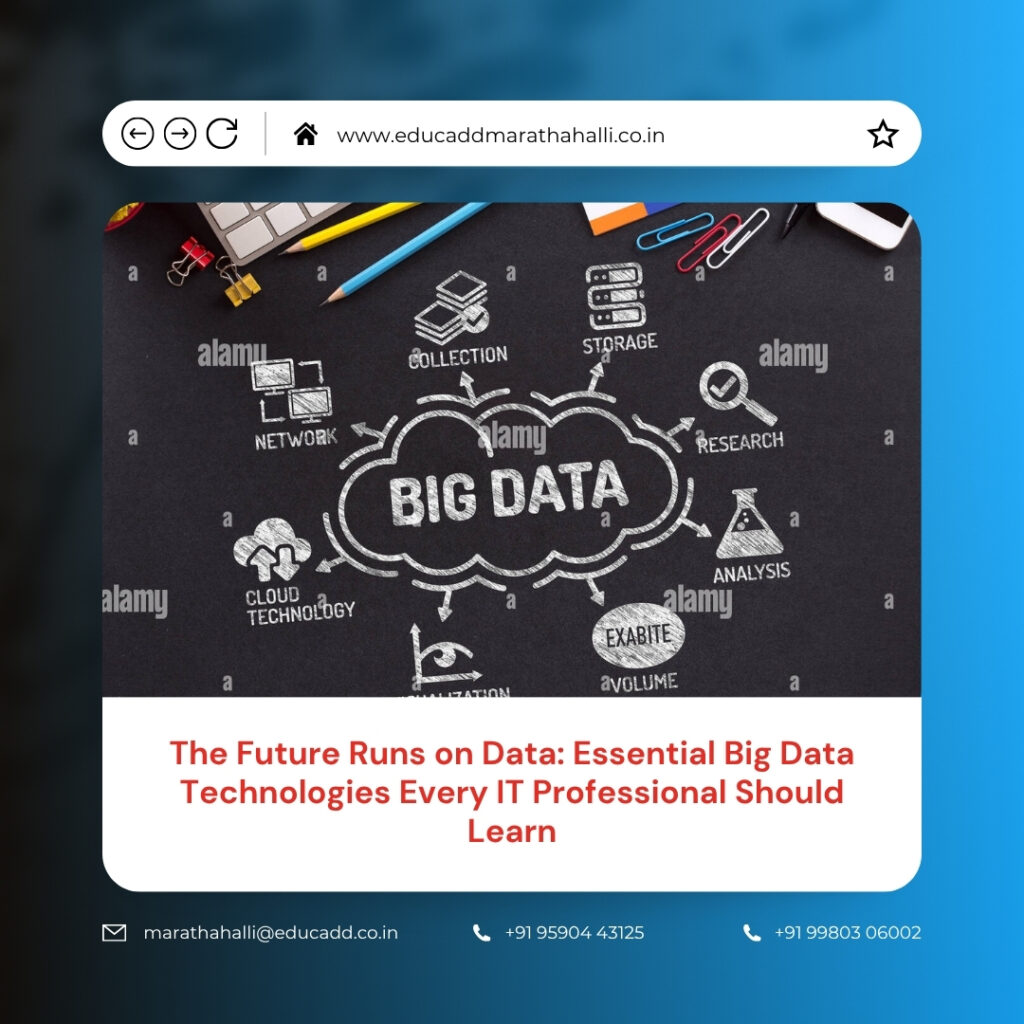
Big Data Technologies Future
Moreover, big data technologies are transforming industries across the world. Businesses now use analytics to predict customer preferences, detect fraud, optimize operations, and improve productivity. Therefore, professionals who learn modern big data tools can stay ahead in a highly competitive job market. This blog explores the most important Big Data Technologies Future every IT professional should master to build a successful and future-ready career.
Why Big Data Technologies Have Become Essential
Big Data Technologies Future are now at the center of digital transformation. Organizations generate enormous amounts of information every day, and they need efficient systems to store, analyze, and process this data without delays. Traditional methods cannot manage such massive workloads effectively. Therefore, companies have started adopting modern big data platforms that provide speed, scalability, and flexibility.
Businesses use big data systems to improve customer experiences, reduce operational costs, and identify market opportunities. For example, e-commerce companies analyze customer behavior to recommend products instantly. Similarly, healthcare organizations use analytics to improve patient care and predict medical trends. Since data-driven decisions improve business performance, companies continue investing heavily in big data technologies.
Additionally, IT professionals who learn big data gain expertise in multiple technical areas such as cloud computing, data engineering, machine learning, and analytics. These skills increase employability and open doors to high-paying roles in different industries. Therefore, learning big data technologies has become a smart career choice for professionals who want long-term growth.
Apache Hadoop and Distributed Data Processing
Apache Hadoop remains one of the most powerful technologies in the big data ecosystem. It was designed to process huge datasets across distributed systems efficiently. Since businesses handle massive volumes of information daily, Hadoop helps organizations store and analyze data without performance issues.
The Hadoop framework consists of important components such as Hadoop Distributed File System (HDFS), MapReduce, and YARN. HDFS stores data across multiple servers, while MapReduce processes data in parallel. Meanwhile, YARN manages system resources and improves operational efficiency.
One of the biggest advantages of Hadoop is scalability. Organizations can expand storage capacity by adding additional nodes instead of replacing the entire infrastructure. Furthermore, Hadoop provides fault tolerance, which ensures continuous operations even when hardware failures occur.
Important benefits of learning Hadoop include:
- Strong knowledge of distributed computing environments
- Better understanding of enterprise-level data management systems
IT professionals who master Hadoop can work on large-scale analytics projects and cloud-based infrastructures. Consequently, Hadoop skills remain highly valuable in the modern technology industry.
Apache Spark and Real-Time Analytics
Apache Spark has become one of the most widely used big data technologies because of its exceptional processing speed. Unlike traditional frameworks that rely heavily on disk storage, Spark performs in-memory processing. As a result, organizations can analyze data significantly faster.
Modern businesses require real-time insights to remain competitive. For example, online streaming platforms monitor user behavior instantly, while banks detect suspicious transactions in real time. Spark supports these requirements by enabling fast data processing and live analytics.
Another major advantage of Spark is its versatility. It supports machine learning, graph processing, SQL analytics, and data streaming through a unified platform. Additionally, Spark works smoothly with programming languages such as Python, Scala, Java, and R.
Furthermore, Spark integrates efficiently with Hadoop and cloud platforms, making it suitable for enterprise environments. IT professionals who learn Spark improve their ability to build scalable and high-performance analytics systems. Therefore, Spark expertise can significantly strengthen career opportunities in data engineering and analytics.
Apache Kafka for Modern Data Streaming
Apache Kafka has transformed the way organizations manage real-time data streams. It is a distributed event streaming platform designed to handle large volumes of information with high reliability and low latency. Because businesses now depend heavily on live data processing, Kafka has become an essential part of modern big data architectures.
Companies use Kafka to transfer information between applications, databases, and analytics systems continuously. For instance, online payment platforms process millions of transactions through Kafka pipelines every day. Similarly, logistics companies use Kafka to track shipments and monitor delivery operations in real time.
Kafka offers impressive scalability and fault tolerance, which makes it highly suitable for enterprise environments. Moreover, it integrates effectively with cloud services, analytics tools, and machine learning frameworks.
Key reasons to learn Kafka include:
- Strong capabilities in real-time event streaming
- High demand in cloud-native and enterprise data environments
IT professionals with Kafka expertise can design powerful streaming systems that support modern digital applications. Consequently, Kafka skills continue gaining importance across industries.
The Growing Demand for NoSQL Databases
Modern applications generate diverse types of information that traditional relational databases cannot always handle efficiently. Therefore, NoSQL databases have become increasingly important in big data technologies. These databases provide flexible data structures and support large-scale distributed environments.
Popular NoSQL databases include MongoDB, Cassandra, Redis, and Couchbase. Each database serves different purposes depending on performance and scalability requirements. For example, MongoDB handles document-based storage efficiently, while Cassandra supports highly distributed applications.
NoSQL databases allow organizations to manage unstructured and semi-structured information effectively. Social media platforms, online gaming systems, and IoT applications rely heavily on these databases for fast performance and scalability.
Additionally, NoSQL systems provide high availability and faster read-write operations compared to traditional databases in certain workloads. Therefore, businesses increasingly adopt NoSQL solutions to support modern applications.
IT professionals who learn NoSQL technologies improve their ability to develop scalable and high-performance systems. As a result, they become more valuable in cloud computing and application development roles.
Cloud Computing and Big Data Integration
Cloud computing has completely changed the way organizations manage big data technologies. Instead of maintaining expensive physical infrastructure, businesses now use cloud platforms to store and process data more efficiently. This shift has improved scalability, flexibility, and operational efficiency across industries.
Major cloud providers such as Amazon Web Services, Microsoft Azure, and Google Cloud offer advanced big data services for analytics, storage, and machine learning. These platforms help organizations manage massive workloads without investing heavily in hardware.
Cloud integration also supports remote access and faster collaboration between teams. Since businesses operate globally, cloud-based big data systems allow employees to access information securely from different locations.
As organizations continue migrating toward cloud-native environments, demand for cloud and big data expertise will grow even further. Therefore, learning cloud integration is essential for future-focused IT professionals.
Data Warehousing for Enterprise Analytics
Data warehousing technologies play a major role in enterprise analytics and business intelligence. These systems collect information from multiple sources and organize it for reporting and analysis. Because organizations depend on accurate insights, data warehouses remain critical for modern decision-making processes.
Popular data warehousing solutions include Snowflake, Amazon Redshift, Google BigQuery, and Azure Synapse Analytics. These platforms provide cloud-based analytics capabilities with high performance and scalability.
Modern data warehouses support fast query execution and advanced reporting features. As a result, businesses can analyze trends, monitor performance metrics, and improve operational planning more effectively.
Furthermore, cloud-based warehouses reduce maintenance costs because organizations no longer need complex on-premise infrastructure. Companies can scale resources according to business requirements while maintaining high efficiency.
IT professionals who understand data warehousing technologies can work in analytics, reporting, and cloud engineering roles. Consequently, these skills continue gaining importance in data-driven organizations.
Machine Learning and Big Data Innovation
Machine learning has become one of the most exciting areas connected to big data technologies. Businesses use machine learning algorithms to analyze patterns, predict outcomes, and automate decisions based on large datasets.
Big data systems provide the massive datasets required for accurate machine learning models. Meanwhile, machine learning frameworks such as TensorFlow, PyTorch, and Scikit-learn help developers create intelligent applications efficiently.
Additionally, machine learning improves automation in industries such as healthcare, retail, manufacturing, and transportation. Therefore, professionals with expertise in both machine learning and big data technologies remain highly valuable.
Learning machine learning also strengthens problem-solving and analytical skills. As a result, IT professionals can explore advanced career opportunities in artificial intelligence and predictive analytics.
Data Visualization and Business Intelligence Tools
Data visualization tools help organizations convert raw information into meaningful insights. Instead of analyzing complex spreadsheets, businesses can use visual dashboards and reports to understand performance quickly.
Popular tools such as Tableau, Microsoft Power BI, and Qlik Sense allow organizations to create interactive reports and monitor business operations effectively. These tools support better communication between technical teams and decision-makers.
Visualization platforms also improve strategic planning because executives can identify trends and performance gaps more easily. Additionally, real-time dashboards help organizations respond quickly to market changes and operational challenges.
Another important advantage of visualization tools is their user-friendly interface. Even non-technical users can understand business insights through charts, graphs, and visual reports.
IT professionals who master data visualization technologies improve both technical and communication skills. Consequently, they become more effective in analytics and business intelligence roles.
Python Programming for Big Data Applications
Python has emerged as one of the most important programming languages in the world of big data technologies. Its simple syntax, flexibility, and extensive libraries make it highly suitable for analytics and data processing tasks.
Python supports frameworks such as Pandas, NumPy, PySpark, TensorFlow, and Matplotlib. These tools help developers perform data analysis, machine learning, automation, and visualization efficiently.
One major advantage of Python is its ability to integrate easily with big data platforms and cloud environments. Therefore, organizations use Python extensively for developing scalable analytics solutions.
Additionally, Python is beginner-friendly, which makes it easier for IT professionals to learn compared to many other programming languages. The strong global developer community also provides extensive support and learning resources.
Professionals who learn Python gain opportunities in data science, artificial intelligence, automation, and cloud computing. As a result, Python remains one of the most valuable skills for modern IT careers.
Cybersecurity Challenges in Big Data Environments
As organizations collect larger amounts of information, protecting sensitive data has become a critical priority. Big data environments often contain confidential customer details, financial records, and business information. Therefore, cybersecurity plays an essential role in modern data systems.
Businesses implement security measures such as encryption, access control, authentication systems, and threat monitoring to protect valuable information. These technologies help organizations prevent unauthorized access and cyberattacks.
Furthermore, companies must comply with data privacy regulations to maintain customer trust and avoid legal issues. Therefore, secure data management practices have become increasingly important.
Cybersecurity professionals with big data expertise can design safer cloud architectures and analytics platforms. Since cyber threats continue evolving, organizations actively seek professionals who understand both security and big data systems.
As digital transformation expands globally, cybersecurity skills combined with big data knowledge will remain highly valuable for IT professionals.
Internet of Things and Big Data Connectivity
The Internet of Things has significantly increased the importance of Big Data Technologies Future. Smart devices continuously generate large amounts of information that organizations analyze to improve operations and customer experiences.
Industries such as healthcare, manufacturing, transportation, and retail rely on IoT devices for real-time monitoring and automation. For example, smart sensors in factories track equipment performance and predict maintenance requirements before failures occur.
Big data systems process this continuous flow of information efficiently. Additionally, analytics tools help organizations identify patterns and improve productivity through data-driven strategies.
IoT integration also supports smart cities, connected healthcare systems, and intelligent transportation networks. Therefore, the combination of IoT and big data technologies will continue shaping the future of digital innovation.
IT professionals who understand IoT connectivity and data analytics gain expertise in one of the fastest-growing technology sectors worldwide.
Career Opportunities in Big Data Technologies
The demand for skilled professionals in big data technologies continues growing rapidly across industries. Organizations need experts who can manage data infrastructure, develop analytics solutions, and support digital transformation initiatives.
Popular career roles include:
- Big Data Engineer
- Data Scientist
- Cloud Data Architect
- Machine Learning Engineer
- Business Intelligence Analyst
- Data Analytics Consultant
These positions often offer excellent salaries, global opportunities, and long-term career growth. Furthermore, industries such as healthcare, finance, e-commerce, and telecommunications actively recruit big data professionals.
Learning multiple technologies such as Hadoop, Spark, Python, cloud platforms, and machine learning significantly improves employability. Additionally, professionals with strong analytical and problem-solving abilities can adapt easily to changing industry requirements.
As businesses continue investing in digital transformation, demand for skilled big data professionals will remain strong for many years.
Conclusion
Big Data Technologies Future are reshaping the modern IT industry and creating enormous opportunities for skilled professionals. Organizations across the world now depend on data-driven strategies to improve decision-making, increase efficiency, and enhance customer experiences. Because of this growing dependence on digital information, expertise in big data technologies has become highly valuable.
Technologies such as Hadoop, Spark, Kafka, NoSQL databases, machine learning platforms, cloud computing services, and data visualization tools are now essential components of modern enterprise systems. Additionally, emerging fields such as IoT integration and cybersecurity continue expanding the scope of big data applications.
IT professionals who continuously upgrade their knowledge and adapt to modern technologies can build strong and successful careers in analytics, artificial intelligence, cloud engineering, and enterprise data management. Since the future of technology revolves around data, learning big data technologies is one of the smartest investments for long-term professional growth and career success.

