
Revolutionizing Green Infrastructure with BIM: The Future of Sustainable Construction
The global construction industry is undergoing a major transformation as sustainability becomes a central focus in modern infrastructure development. Governments, architects, engineers, and construction companies now prioritize eco-friendly practices to reduce environmental damage and create energy-efficient buildings. Traditional construction methods often result in excessive material waste, high energy consumption, and increased operational costs. Therefore, the demand for smarter construction technologies has grown rapidly in recent years. Among the many innovations shaping the industry, Building Information Modeling, widely known as BIM, has emerged as one of the most powerful Green Infrastructure BIM Solutions.
BIM is not just a digital modeling tool. Instead, it is a complete process that improves project planning, design, execution, and facility management. Through intelligent 3D models and real-time collaboration, BIM helps construction professionals make accurate decisions while reducing environmental impact. Sustainable construction projects now rely heavily on BIM technology to optimize energy performance, reduce waste generation, and improve overall building efficiency. Because of these advantages, companies worldwide actively seek professionals trained in BIM and green building practices.
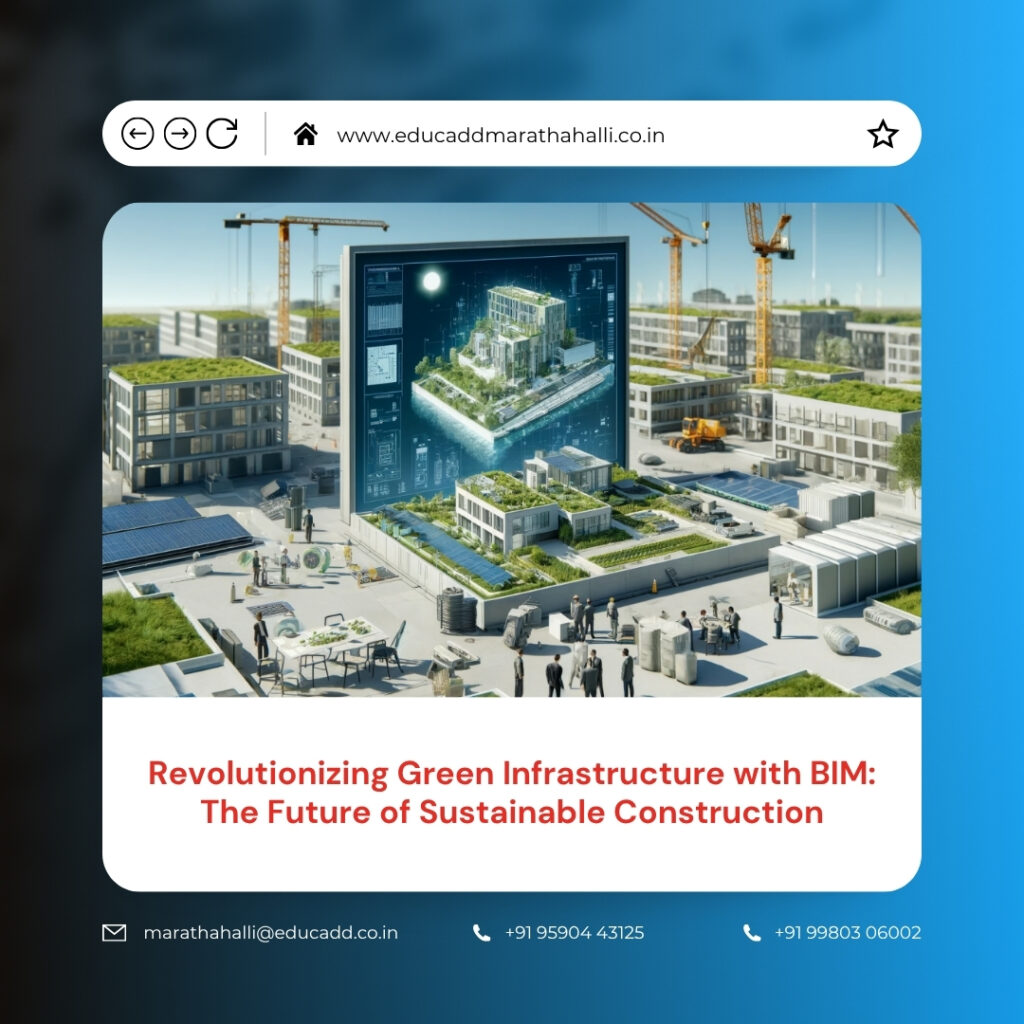
Green Infrastructure BIM Solutions
A Green Infrastructure BIM Solutions equips students and working professionals with advanced technical skills that match modern industry demands. The course focuses on sustainable design concepts, digital construction workflows, energy analysis, and project coordination. As green construction continues to expand globally, BIM expertise offers excellent long-term career opportunities in architecture, engineering, and infrastructure development.
Understanding the Concept of BIM in Sustainable Construction
Building Information Modeling is a smart digital process used for designing, constructing, and managing infrastructure projects with improved accuracy and coordination. Unlike conventional CAD drawings, BIM creates intelligent models containing detailed information about every component of a building. These digital models help project teams collaborate efficiently throughout the entire construction lifecycle.
In sustainable construction, BIM acts as a powerful decision-making tool. Designers and engineers can analyze building performance before construction even begins. This allows professionals to identify energy-saving opportunities, reduce resource consumption, and improve project efficiency from the early stages itself.
One of the biggest advantages of BIM is its ability to centralize project information. Architects, structural engineers, MEP consultants, and contractors can work together on a single digital platform. Consequently, communication improves significantly, and project errors decrease considerably.
Today, sustainable infrastructure projects increasingly depend on BIM because it supports smarter planning, better visualization, and environmentally responsible construction practices.
Why Sustainable Construction Matters More Than Ever
Environmental concerns have become one of the biggest global challenges of the modern era. Rapid urbanization, industrial growth, and population expansion continue to increase pressure on natural resources. The construction industry alone contributes significantly to carbon emissions, energy consumption, and material waste generation. Therefore, adopting sustainable construction methods has become essential for protecting the environment and ensuring long-term development.
Sustainable construction focuses on reducing negative environmental impacts while improving building performance and occupant well-being. Green buildings consume less energy, generate lower emissions, and utilize resources more efficiently compared to conventional structures.
Several important factors are driving the growth of sustainable construction worldwide:
- Rising awareness about climate change and environmental conservation
- Increasing demand for energy-efficient and eco-friendly infrastructure
Additionally, governments and regulatory authorities now encourage green construction through environmental policies and sustainability certifications. As a result, construction companies are investing heavily in advanced technologies like BIM to achieve sustainability goals more effectively.
How BIM Improves Sustainable Building Design
Green Infrastructure BIM Solutions by enabling accurate analysis and efficient project planning. Before actual construction begins, professionals can evaluate different design alternatives and identify the most environmentally responsible solutions. This proactive approach minimizes costly modifications during later project stages.
Using BIM software, architects can study natural lighting, thermal performance, airflow, and energy efficiency with remarkable precision. Engineers can optimize building orientation, insulation systems, and ventilation strategies for better environmental performance. Consequently, buildings become more energy-efficient and cost-effective over their operational lifespan.
BIM also supports material optimization. Accurate quantity estimation helps reduce unnecessary procurement and material wastage. Since construction teams work collaboratively through a centralized platform, clashes and coordination issues are identified early.
Furthermore, BIM contributes to long-term sustainability by improving facility management after project completion. Building owners can use BIM data to monitor maintenance schedules, equipment performance, and operational efficiency throughout the building lifecycle.
Reducing Construction Waste Through BIM Technology
Construction waste remains one of the most serious issues affecting the global building industry. Poor coordination, inaccurate planning, and design conflicts often lead to excessive material usage and project inefficiencies. However, BIM technology offers highly effective solutions for minimizing waste generation during construction activities.
Through intelligent 3D visualization, BIM allows project teams to detect clashes between structural, architectural, and MEP components before on-site execution begins. This reduces rework, demolition, and unnecessary material loss significantly.
BIM-generated quantity takeoffs also improve procurement accuracy. Contractors can estimate exact material requirements, which prevents over-ordering and storage-related waste. As a result, projects become more cost-efficient and environmentally responsible.
Another important benefit involves improved scheduling and logistics management. BIM enables better coordination of resources and construction timelines, reducing delays and material damage caused by poor site management.
By minimizing waste and improving efficiency, BIM supports sustainable construction practices while helping organizations achieve better environmental performance standards.
Energy Optimization and BIM Integration
Energy efficiency has become a key objective in modern construction projects. Buildings that consume excessive energy not only increase operational costs but also contribute heavily to environmental pollution. BIM technology helps solve this problem by enabling advanced energy analysis during the design stage.
Using BIM-based simulation tools, professionals can analyze heating, cooling, lighting, and ventilation performance under different environmental conditions. This allows architects and engineers to create optimized building designs that consume less energy while maintaining occupant comfort.
Some major energy optimization benefits of BIM include:
- Improved natural lighting and reduced electricity consumption
- Better HVAC system planning for enhanced energy efficiency
BIM additionally supports renewable energy integration such as solar panels, rainwater harvesting systems, and smart energy management technologies. Consequently, buildings achieve improved sustainability performance and lower carbon footprints.
As energy regulations continue becoming stricter worldwide, BIM-driven energy modeling is rapidly becoming an essential requirement for modern construction projects.
Advantages of Learning BIM for Sustainable Construction
A BIM for sustainable construction course provides learners with valuable technical skills and practical industry exposure. The course combines advanced digital construction techniques with green building principles, making it highly beneficial for students and working professionals alike.
Learners gain hands-on experience with industry-standard BIM software used in architecture, engineering, and construction sectors. They also develop knowledge about sustainable design strategies, project coordination, energy analysis, and lifecycle management.
One of the most significant benefits of BIM training is improved employability. Construction companies increasingly prefer professionals who can contribute to sustainable infrastructure projects through digital technologies. Therefore, certified BIM professionals often receive better career opportunities and higher salary packages.
The course also enhances problem-solving and project management abilities. Students learn how to identify design conflicts, improve resource utilization, and manage construction workflows efficiently.
As the construction industry continues evolving digitally, BIM expertise has become one of the most valuable technical skills in the global job market.
Core Skills Covered in BIM Training Programs
Modern BIM training programs focus on both theoretical understanding and practical implementation. Students receive comprehensive exposure to digital construction technologies and sustainable infrastructure concepts.
The course usually includes modules related to 3D modeling, clash detection, quantity estimation, project coordination, construction documentation, and BIM collaboration workflows. In addition, learners study green building standards, sustainability analysis, and energy-efficient design principles.
Communication and teamwork also form an important part of BIM education. Since construction projects involve multiple disciplines, professionals must coordinate effectively with architects, engineers, and contractors.
Many institutes additionally provide live project training and industry-oriented case studies. This practical exposure helps students understand real-world project challenges and develop confidence in handling professional responsibilities.
By mastering these skills, learners become well-prepared for modern construction industry requirements and future technological advancements.
Career Opportunities in BIM and Sustainable Construction
The demand for BIM professionals continues growing rapidly across the global construction and infrastructure industry. Organizations now require experts capable of combining digital construction technologies with sustainable building practices. Consequently, completing a BIM for sustainable construction course opens the door to diverse career opportunities.
Graduates can work as BIM modelers, BIM coordinators, sustainability consultants, project engineers, construction planners, or energy analysts. Large construction firms, architectural companies, and infrastructure developers actively recruit skilled BIM professionals for complex projects.
International opportunities are also expanding significantly. Countries investing in smart cities, metro systems, airports, and green infrastructure projects require BIM specialists to improve efficiency and sustainability performance.
Freelancing opportunities have additionally increased in recent years. Experienced BIM professionals can provide remote modeling, coordination, and sustainability consulting services to clients worldwide.
With continuous technological advancements and growing sustainability awareness, BIM careers offer excellent long-term stability and professional growth.
BIM’s Contribution to Smart Cities Development
Smart cities aim to create efficient, sustainable, and technologically advanced urban environments. BIM technology plays an essential role in supporting smart city infrastructure planning and management.
Using BIM, planners can design integrated transportation systems, energy networks, water management systems, and public infrastructure more effectively. Digital models improve visualization, coordination, and data management for large-scale urban development projects.
BIM also supports predictive maintenance and facility management in smart cities. Authorities can monitor infrastructure performance, identify maintenance requirements, and optimize resource allocation using digital information systems.
Moreover, BIM integrates effectively with emerging technologies such as IoT, artificial intelligence, and digital twins. These innovations improve operational efficiency and support sustainable urban growth.
As governments continue investing in modern infrastructure development, the role of BIM in smart city planning will become even more important in the coming years.
Challenges in Sustainable Construction and BIM Solutions
Although sustainable construction offers numerous advantages, the industry still faces several implementation challenges. High initial costs, limited technical expertise, and resistance to technological adoption often create obstacles for many organizations.
However, BIM technology helps address these challenges through improved planning, coordination, and efficiency. Accurate digital models reduce design errors, material wastage, and project delays, leading to long-term cost savings.
Another major challenge involves the shortage of skilled professionals. Many companies struggle to find experts capable of handling advanced digital construction workflows. BIM training programs help bridge this gap by preparing students with industry-relevant technical skills.
Data management complexity also affects large-scale construction projects. BIM solves this issue by centralizing project information on a single collaborative platform. Consequently, communication improves and decision-making becomes more efficient.
As awareness and training continue expanding, more organizations are adopting BIM-driven sustainable construction strategies to remain competitive in the modern industry.
Emerging Trends Shaping the Future of BIM
The future of Green Infrastructure BIM Solutions appears extremely promising as new technologies continue transforming the construction landscape. Advanced digital innovations are improving efficiency, sustainability, and project management capabilities across the industry.
Artificial intelligence and machine learning are increasingly integrating with BIM systems. These technologies automate project analysis, optimize design decisions, and improve construction accuracy.
Cloud-based BIM platforms have also revolutionized project collaboration. Teams located in different geographical regions can now access real-time project information and coordinate efficiently from anywhere.
Virtual reality and augmented reality further enhance BIM visualization capabilities. Clients, engineers, and contractors can experience virtual walkthroughs before construction begins, improving project understanding and reducing design misunderstandings.
In addition, stricter sustainability regulations worldwide continue driving BIM adoption. Companies increasingly depend on digital construction technologies to achieve environmental compliance and operational efficiency.
Why Employers Prefer BIM-Certified Professionals
Construction companies highly value BIM-certified professionals because they bring technical expertise, productivity, and sustainability knowledge to projects. Certified candidates understand modern construction workflows and contribute effectively from the beginning.
BIM professionals improve project coordination and reduce costly on-site errors through accurate digital modeling and collaboration. Their technical abilities help organizations complete projects faster and more efficiently.
Employers also prioritize sustainability-focused professionals as green building demand continues rising globally. Skilled BIM experts capable of implementing eco-friendly construction practices are now essential for many organizations.
Certification additionally demonstrates practical software proficiency and professional readiness. This gives candidates a strong advantage during recruitment and career advancement processes.
Because of rapid digital transformation across the construction industry, BIM-certified professionals remain among the most sought-after experts worldwide.
Selecting the Best BIM Training Institute
Choosing the right BIM training institute plays a crucial role in building a successful career. Students should select institutes that offer practical training, updated curriculum, experienced trainers, and industry-oriented learning methods.
A high-quality BIM course must include software training, sustainability concepts, live projects, and placement assistance. Hands-on exposure helps learners understand actual construction workflows and professional requirements.
Students should also evaluate factors such as lab facilities, project-based assignments, internship opportunities, and certification recognition before enrolling in a course.
Industry collaboration is another important consideration. Institutes connected with construction companies and software providers often deliver better career support and updated training programs.
By selecting the right institute, students can develop strong technical foundations and improve their career opportunities in sustainable construction and digital infrastructure management.
Conclusion
Green Infrastructure BIM Solutions has completely transformed the modern building industry by combining digital innovation with environmentally responsible practices. From reducing material waste and optimizing energy performance to improving project coordination and smart city development, BIM continues shaping the future of infrastructure worldwide.
A BIM for sustainable construction course provides students and professionals with advanced technical knowledge, practical experience, and career-focused skills required in today’s competitive industry. As global demand for green buildings and digital construction technologies increases, BIM expertise offers outstanding professional growth opportunities.
The future of construction depends heavily on sustainability, efficiency, and intelligent project management. Therefore, individuals who develop BIM skills today will play a major role in creating smarter, greener, and future-ready infrastructure for the next generation.

