
The Ultimate Interior Design Course Blueprint: What You Really Learn from Classroom to Career
Many aspiring designers step into the field with excitement, yet they often lack clarity about what they will actually study. Interior Design Course Blueprint is far more than selecting colors and arranging furniture. It is a structured discipline that blends creativity, psychology, engineering basics, technology, and business skills. To succeed in this industry, students must move through a carefully designed academic path that builds both artistic confidence and technical mastery.
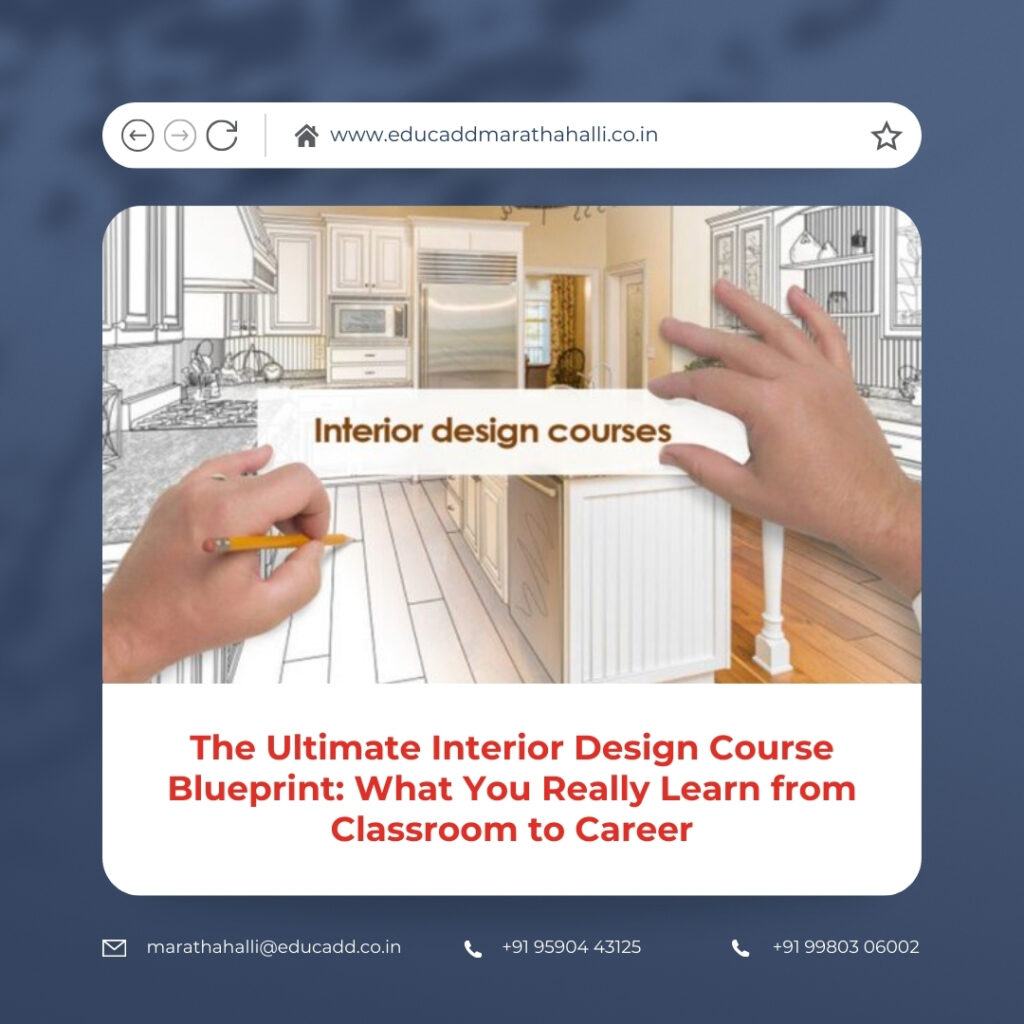
Interior Design Course Blueprint
This comprehensive guide explores the complete interior design course structure in depth. Each stage contributes to shaping a student into a professional who can conceptualize, design, execute, and manage projects independently. From foundational theory to advanced specialization, every module serves a specific purpose. By understanding the full blueprint of an interior design program, you will gain clarity about how your skills evolve and how education prepares you for a competitive marketplace.
1. Design Foundations: Building the Creative Core
Every strong Interior Design Course Blueprint begins with a solid understanding of fundamental design principles. This initial stage focuses on nurturing creativity while teaching students to think analytically about visual composition. You explore elements such as line, shape, form, texture, balance, rhythm, contrast, proportion, and unity. These concepts may appear simple at first glance, yet they form the backbone of every well-designed space.
Students learn how to create harmony between objects and surroundings. They examine how scale affects perception and how repetition can build visual consistency. Through structured exercises, learners begin to interpret space thoughtfully rather than randomly decorating it. Critiques and discussions further sharpen observation skills, encouraging students to evaluate design choices with clarity.
Moreover, this foundational training strengthens creative confidence. Instead of relying on trends, students learn to apply design logic. As a result, they gain the ability to justify their decisions professionally. This core stage ensures that all future technical subjects rest on a stable artistic base.
2. Sketching and Visual Representation: Communicating Ideas Effectively
A designer’s ideas hold value only when they can be communicated clearly. Therefore, drawing and visual representation play a central role in interior design education. Students practice freehand sketching to improve hand coordination and observation. They learn perspective drawing techniques to accurately depict depth and dimensions.
Technical drawing soon follows. Floor plans, elevations, and sectional views become part of daily practice. Precision matters significantly at this stage because accurate drawings guide actual construction. In addition, rendering techniques help transform simple outlines into visually engaging presentations.
Gradually, students understand how to convert abstract thoughts into structured visuals. This process enhances both clarity and confidence. Whether presenting to faculty, peers, or future clients, effective visual communication becomes a powerful professional tool. Through consistent practice, learners develop the ability to translate imagination into detailed, practical designs.
3. Historical Evolution of Interiors: Learning from the Past
Interior Design Course Blueprint did not emerge overnight. It evolved over centuries under the influence of culture, climate, art movements, and technological advancements. A well-rounded curriculum introduces students to this historical progression. By studying ancient civilizations, classical European styles, colonial influences, and modern design movements, learners gain valuable perspective.
Students examine how architecture and interiors responded to social change. For example, industrialization led to minimalism and functionalism, while royal eras emphasized ornamentation and luxury. Understanding these transitions helps designers identify recurring patterns and enduring principles.
Furthermore, historical knowledge encourages originality. Instead of copying current trends, students learn to reinterpret classical ideas in contemporary contexts. This awareness deepens creative maturity and supports more meaningful design narratives. By appreciating the past, designers create spaces that feel both timeless and innovative.
4. Space Planning and Functional Design Strategies
Interior design extends far beyond aesthetics. Functionality determines whether a space truly works. Consequently, space planning becomes a central subject in professional training. Students learn to analyze room dimensions carefully and organize areas based on usage requirements.
Circulation patterns receive special attention. Designers must ensure smooth movement within a space without obstruction. Zoning techniques help separate public, private, and service areas effectively. Through practical assignments, students design residential layouts before advancing to commercial and institutional projects.
This progression strengthens logical thinking. Learners begin to approach design challenges systematically rather than emotionally. They evaluate user needs, furniture placement, lighting access, and accessibility requirements. By mastering functional planning, students ensure that their designs serve real human behavior efficiently.
5. Materials, Finishes, and Construction Fundamentals
Creativity must align with practicality. Therefore, material knowledge forms an essential part of interior design education. Students explore various materials such as wood, glass, stone, metals, laminates, fabrics, and eco-friendly alternatives. Each material has unique characteristics related to durability, maintenance, texture, and cost.
In addition, construction basics are introduced to bridge design and execution. Learners understand wall systems, ceiling frameworks, flooring installation, and partition methods. This technical exposure helps them design responsibly.
When students grasp material behavior, they avoid unrealistic concepts. They also learn how finishes influence mood and longevity. This knowledge allows designers to make informed decisions that balance beauty, safety, and budget. As a result, their proposals become both imaginative and feasible.
6. Furniture Design and Ergonomic Principles
Furniture defines comfort within any interior. Hence, students dedicate time to understanding both design aesthetics and ergonomic science. Ergonomics focuses on adapting furniture dimensions to human measurements. Proper chair height, table proportions, and storage accessibility ensure comfort and functionality.
Learners study anthropometric data and apply it while designing custom pieces. Additionally, they explore joinery techniques and structural stability. This hands-on exposure enhances technical confidence.
By combining artistic creativity with ergonomic awareness, students create furniture that looks appealing while supporting physical well-being. This module also nurtures product innovation skills, enabling future designers to develop signature pieces tailored to client needs.
7. Lighting Design and Spatial Ambience
Lighting influences perception more than most people realize. An effective curriculum introduces students to both natural and artificial lighting systems. They learn how daylight affects mood and productivity. Simultaneously, they explore artificial lighting types such as ambient, task, and accent lighting.
Students calculate appropriate placement and intensity levels. They examine color temperature and its psychological impact. Furthermore, they understand how layered lighting enhances depth within interiors.
Through practical exercises, learners design lighting plans that complement architectural features. By mastering illumination techniques, designers gain the power to transform ordinary rooms into dynamic environments.
8. Color Psychology and Creative Application
Color significantly affects human emotions. Therefore, students receive detailed training in color theory and psychology. They study primary, secondary, and tertiary color relationships while exploring harmony schemes such as complementary and analogous combinations.
Mood board creation becomes an essential activity. Through experimentation, learners observe how subtle color variations influence atmosphere. Warm shades may create energy, while cool tones promote calmness.
This subject also teaches strategic application. Designers must consider lighting conditions, room size, and user preferences before finalizing palettes. As students refine their understanding, they develop the ability to design emotionally engaging environments.
9. Digital Tools and 3D Visualization
Modern interior design relies heavily on technology. Educational programs integrate computer-aided drafting and modeling software early in the course. Students learn digital drafting to create accurate floor plans and construction drawings.
Three-dimensional modeling software enables realistic visualization. Rendering tools further enhance presentation quality. By producing lifelike images, students communicate concepts effectively to clients.
Digital proficiency increases professional competitiveness. Employers prefer designers who can blend manual creativity with technological efficiency. Consequently, mastering software tools significantly boosts career readiness.
10. Sustainable and Environmentally Responsible Design
Sustainability has become a global priority. Interior design education now emphasizes environmentally responsible practices. Students learn to reduce energy consumption through efficient planning and ventilation strategies.
They also explore sustainable materials that minimize environmental impact. Waste management, recycling practices, and green certifications receive thorough discussion. This awareness fosters ethical responsibility.
Designers who prioritize sustainability contribute positively to society. By integrating eco-friendly concepts, they create healthier living environments while supporting long-term environmental goals.
11. Budgeting, Documentation, and Project Coordination
Professional practice extends beyond creativity. Students must understand financial planning and project management. Budget estimation, cost calculation, and vendor coordination become essential learning areas.
They prepare working drawings and documentation required for execution. Time management and communication skills are also developed. Through simulated projects, learners experience realistic challenges.
This exposure prepares them to handle client expectations confidently. By mastering coordination skills, future designers ensure smooth project completion within deadlines and budgets.
12. Portfolio Development and Professional Branding
A well-crafted portfolio serves as a designer’s identity. Throughout the course, students compile academic projects into a structured presentation. Faculty guide them in layout design and storytelling techniques.
Each portfolio piece highlights conceptual thinking, technical accuracy, and creativity. Students learn how to present their work persuasively during interviews and client meetings.
Professional branding also becomes part of this stage. Learners understand the importance of personal style, online presence, and networking. A strong portfolio significantly enhances employment opportunities.
13. Internship and Real-World Industry Experience
Academic knowledge gains strength through practical exposure. Internships allow students to work with established design firms. They participate in site visits, client interactions, and material selection processes.
Real-world challenges improve adaptability and discipline. Students observe project timelines and construction coordination firsthand. This experience bridges classroom learning with professional practice.
Many learners secure employment opportunities through internship connections. Thus, industry exposure accelerates career growth while building confidence.
14. Final Capstone Project and Area of Specialization
The concluding stage of the program involves a comprehensive final project. Students choose a specialization such as residential, commercial, retail, or hospitality design. They conduct research, develop concepts, and create detailed drawings.
This project integrates all previously learned skills, from space planning to lighting and budgeting. Faculty mentorship ensures refinement and technical accuracy.
The final presentation demonstrates readiness for professional life. It reflects creative maturity, analytical ability, and presentation confidence. This capstone experience marks the transformation from student to designer.
Conclusion
An Interior Design Course Blueprint offers far more than decorative knowledge. It provides a structured journey that nurtures creativity, builds technical expertise, and develops business understanding. Each subject connects logically to the next, ensuring progressive skill enhancement.
From mastering design fundamentals to completing a specialization project, students grow steadily into capable professionals. Practical exposure, digital training, and portfolio development further strengthen employability.
When you understand the complete blueprint of interior design education, you approach your career path with clarity and confidence. This structured academic journey ultimately transforms artistic passion into professional mastery, equipping designers to shape inspiring and functional spaces in an ever-evolving industry.

