
From Risky Releases to Reliable Rollouts: DevOps Tools That Reduce Deployment Failures
Software delivery has transformed dramatically over the past decade. Organizations now release updates weekly, daily, or even hourly. While this speed fuels innovation, it also increases operational risk. A single flawed deployment can interrupt services, damage reputation, and reduce revenue. Therefore, teams must adopt structured practices that protect production environments. This is exactly where DevOps Deployment Failure Reduction prove essential.
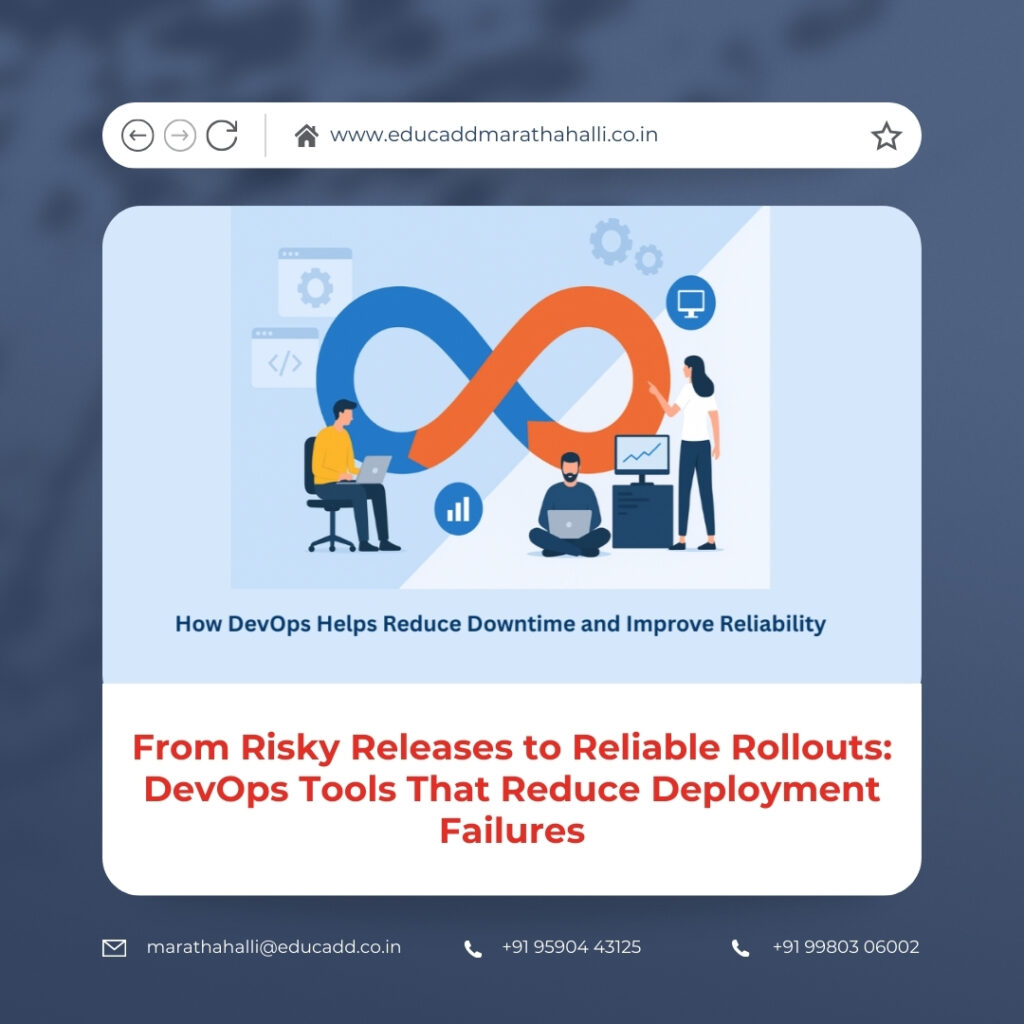
DevOps Deployment Failure Reduction
Modern DevOps focuses on automation, collaboration, and continuous improvement. Instead of treating deployment as a final event, high-performing teams treat it as a controlled, repeatable process. They rely on automation pipelines, infrastructure management systems, testing frameworks, and monitoring platforms to prevent errors before they reach users. When teams implement the right DevOps tools that reduce deployment failures, they build stable systems that support rapid innovation without compromising reliability. This guide explores those tools in depth and explains how each one strengthens deployment confidence.
1. The Real Causes Behind Deployment Breakdowns
Before selecting solutions, teams must understand why deployments fail. In most cases, failures stem from inconsistent environments, manual configuration steps, miscommunication between teams, or insufficient validation. Even minor differences between development and production environments can introduce unexpected bugs. Therefore, consistency becomes critical.
Human error also contributes significantly. Manual server configuration, undocumented processes, or last-minute code changes increase risk. Furthermore, poor coordination between development and operations teams creates confusion during release cycles. Without shared visibility, issues often remain hidden until customers report them.
Another common cause involves incomplete testing. When teams rush releases without adequate validation, hidden defects slip into production. Consequently, identifying and fixing these issues becomes more expensive. DevOps tools that reduce deployment failures address these root causes through automation, traceability, and standardized workflows. By eliminating guesswork, teams create dependable release mechanisms.
2. Continuous Integration as the First Safety Layer
Continuous Integration (CI) forms the backbone of reliable software delivery. CI systems automatically build and test code whenever developers commit changes. This approach identifies integration problems early, long before deployment begins. Because developers merge smaller code changes frequently, troubleshooting becomes simpler.
Tools such as Jenkins, GitHub Actions, and GitLab CI automate compilation, dependency installation, and test execution. Whenever a test fails, the system alerts developers immediately. This rapid feedback loop prevents unstable code from advancing further in the pipeline.
Moreover, CI enforces consistent coding standards and automated quality checks. Static code analysis tools detect syntax issues, security vulnerabilities, and formatting inconsistencies. Therefore, CI stands among the most impactful DevOps tools that reduce deployment failures. It ensures that only validated code proceeds to later stages, reducing last-minute surprises.
3. Continuous Delivery and Controlled Release Automation
While CI ensures code quality, Continuous Delivery (CD) prepares applications for reliable deployment. CD pipelines automate packaging, artifact storage, staging deployments, and production promotions. Each stage follows predefined rules, eliminating unpredictable manual steps.
Continuous Deployment extends this concept further by automatically releasing validated updates to production. However, this approach requires strong testing practices and mature monitoring systems. When implemented correctly, automated release systems reduce human intervention and shorten deployment cycles.
Modern CD platforms support advanced techniques like blue-green deployments and canary releases. Blue-green strategies maintain two identical production environments. One serves live users, while the other receives updates. If problems arise, traffic shifts instantly to the stable environment. Canary deployments release updates gradually to a small user segment before expanding globally. These strategies represent practical DevOps Deployment Failure Reduction by limiting exposure during risky updates.
4. Version Control Systems That Strengthen Accountability
Version control systems provide structure and traceability across development workflows. Git-based platforms allow teams to track changes, manage branches, and conduct structured code reviews. Every modification remains documented, which simplifies debugging and auditing.
Pull request reviews encourage collaboration and knowledge sharing. When developers review each other’s changes, they identify logical flaws and potential security risks before merging. This collaborative step significantly lowers deployment errors.
Branching strategies also improve stability. For instance, trunk-based development keeps the main branch stable, while feature branches isolate experimental changes. Because version control systems maintain a detailed history of modifications, they rank among the most reliable DevOps tools that reduce deployment failures. Teams always know what changed, who changed it, and why.
5. Infrastructure as Code for Predictable Environments
Environment inconsistency remains a primary cause of release problems. Infrastructure as Code (IaC) solves this issue by defining infrastructure configurations through code files. Instead of manually provisioning servers, teams use tools like Terraform or AWS CloudFormation to automate infrastructure setup.
IaC ensures that development, staging, and production environments share identical configurations. When teams need new infrastructure, they generate it from reusable templates. This repeatability eliminates configuration drift and manual setup errors.
Furthermore, IaC integrates with version control systems. Teams review infrastructure changes just like application code. If issues appear, they roll back configurations quickly. Because it guarantees environmental consistency, IaC stands out among DevOps tools that reduce deployment failures and enhance scalability.
6. Configuration Management for Ongoing Stability
Provisioning infrastructure is only the beginning. Systems require ongoing configuration management to maintain stability. Tools such as Ansible, Chef, and Puppet enforce desired server states continuously. They ensure that applications, dependencies, and security patches remain consistent across machines.
Without configuration management, small deviations accumulate over time. These subtle differences often trigger unexpected behavior during deployments. However, automated configuration enforcement detects and corrects discrepancies immediately.
In addition, configuration management tools simplify compliance requirements. They standardize patch management and ensure consistent security policies. Therefore, they represent another essential category of DevOps tools that reduce deployment failures by maintaining predictable operating environments.
7. Containerization for Environment Portability
Containers revolutionized deployment reliability. Technologies like Docker package applications and dependencies into lightweight, portable units. This packaging eliminates compatibility conflicts between environments.
When developers build container images, they define exact runtime requirements. Production environments then execute identical containers, ensuring consistency. Because containers isolate applications from underlying infrastructure, they reduce unexpected runtime errors.
Moreover, container registries store versioned images. Teams deploy specific tags, preventing confusion about which version runs in production. As a result, containerization serves as one of the most transformative DevOps tools that reduce deployment failures. It simplifies portability, scalability, and environment control.
8. Orchestration Platforms for Automated Resilience
While containers simplify packaging, orchestration platforms manage them at scale. Kubernetes automates container scheduling, scaling, and recovery. If a container crashes, the system restarts it automatically. This self-healing capability reduces downtime significantly.
Rolling updates allow Kubernetes to replace containers gradually, avoiding service interruptions. If errors occur, automated rollback mechanisms restore stable versions immediately. These features ensure service continuity even during complex updates.
Additionally, orchestration platforms distribute workloads across clusters to prevent overload. By maintaining balanced resource utilization, they prevent performance-related deployment failures. Therefore, orchestration systems remain critical DevOps tools that reduce deployment failures in high-demand environments.
9. Automated Testing for Comprehensive Validation
Testing protects software quality at every stage. Automated test suites evaluate functionality, performance, and security before deployment. Unit tests validate individual components. Integration tests confirm interactions between services. End-to-end tests simulate real user behavior.
Performance testing ensures applications handle expected traffic loads. Meanwhile, security testing identifies vulnerabilities early in the pipeline. When integrated into CI/CD pipelines, these tests create a strong validation framework.
Because automated testing catches defects before production, it qualifies as one of the most reliable DevOps tools that reduce deployment failures. Teams gain confidence in each release, knowing that extensive validation supports it.
10. Observability and Monitoring for Early Detection
Even with rigorous testing, production environments require constant observation. Monitoring systems track metrics such as CPU usage, response times, and error rates. Logging platforms collect detailed records of system events.
Observability extends further by incorporating distributed tracing. This approach maps requests across microservices, identifying bottlenecks quickly. When monitoring systems detect anomalies, they trigger alerts instantly.
Fast detection minimizes damage. Teams respond before minor issues escalate into outages. Consequently, monitoring platforms function as proactive DevOps tools that reduce deployment failures and strengthen operational awareness.
11. Feature Flags for Safer Feature Releases
Feature flag systems allow teams to separate code deployment from feature activation. Developers deploy new functionality but keep it disabled until ready. If issues emerge, teams disable the feature without redeploying.
This flexibility reduces risk significantly. Teams experiment safely with limited audiences before full-scale rollout. Feature flags also support A/B testing strategies.
By providing granular release control, feature flag systems operate as strategic DevOps tools that reduce deployment failures. They allow teams to maintain production stability while introducing innovation gradually.
12. Integrated Security Within the Pipeline
Security should never appear as an afterthought. DevSecOps integrates security testing directly into CI/CD pipelines. Static analysis tools scan code for vulnerabilities. Dependency scanners identify outdated libraries. Container security platforms inspect images for risks.
By automating these checks, teams detect vulnerabilities early. Early detection prevents emergency patches during deployment windows. Additionally, automated compliance verification ensures adherence to regulatory standards.
Because security flaws often cause deployment delays or rollbacks, integrated security platforms rank among the most vital DevOps tools that reduce deployment failures.
13. Incident Response and Rapid Recovery Mechanisms
Even mature systems encounter unexpected issues. Effective incident response frameworks minimize impact when failures occur. Alerting platforms notify responsible teams immediately. Centralized dashboards provide real-time insights.
Automated rollback mechanisms restore stable versions quickly. Clear documentation and post-incident reviews strengthen future prevention strategies. When teams analyze root causes thoroughly, they enhance resilience.
Incident management systems therefore serve as essential DevOps tools that reduce deployment failures by shortening recovery time and improving response coordination.
14. Creating a Unified DevOps Ecosystem for Long-Term Success
Tools alone do not guarantee reliability. Organizations must integrate them into cohesive workflows. A unified pipeline connects CI systems, automated testing, infrastructure provisioning, container orchestration, monitoring, and incident management.
Each component reinforces the others. For example, CI validates code before CD pipelines promote it. Infrastructure as Code ensures consistent environments. Monitoring systems validate deployment health in real time. Incident tools coordinate recovery if necessary.
Moreover, organizations must foster a culture of collaboration and continuous improvement. Teams should review deployment metrics regularly and refine processes accordingly. When technology aligns with culture, DevOps Deployment Failure Reduction unlock their full potential.
Conclusion
Reliable deployments require more than speed. They demand structure, transparency, and automation. By implementing DevOps Deployment Failure Reduction across development, testing, infrastructure, and monitoring, organizations transform risky releases into controlled operations.
Continuous integration catches errors early. Continuous delivery standardizes releases. Infrastructure as Code eliminates configuration drift. Containers and orchestration provide scalability and resilience. Automated testing safeguards quality. Monitoring systems ensure real-time awareness. Security integration protects integrity. Incident response mechanisms minimize downtime.
When these elements operate together, deployments become predictable and repeatable. Teams deliver innovation confidently without sacrificing stability. Ultimately, DevOps tools that reduce deployment failures empower organizations to balance agility with reliability, ensuring long-term operational excellence.

