
Precision Perfected: How Civil CADD Elevates Accuracy in Modern Construction Drawings
Civil CADD Drawing Accuracy forms the backbone of every successful construction project. Whether it is a residential building, a commercial complex, or a large-scale infrastructure development, precise construction drawings determine how smoothly the project moves from concept to completion. When drawings contain inconsistencies, unclear measurements, or design clashes, the entire workflow suffers. Delays increase, budgets stretch, and structural risks emerge. In today’s highly competitive construction environment, professionals cannot afford such setbacks. They need dependable digital systems that eliminate manual errors and ensure technical precision at every stage.
This is where Civil CADD becomes indispensable. Civil CADD is not merely a drafting tool; it is a comprehensive design environment tailored for civil engineering and construction documentation. It enables engineers, architects, and designers to create highly accurate, detailed, and standardized drawings with confidence. By integrating automated calculations, intelligent dimensioning, layer management, and real-time updates, Civil CADD minimizes human error and enhances coordination across teams. As construction projects grow more complex, the demand for reliable and precise documentation continues to rise. Civil CADD answers that demand by transforming traditional drafting practices into data-driven, accuracy-focused workflows.
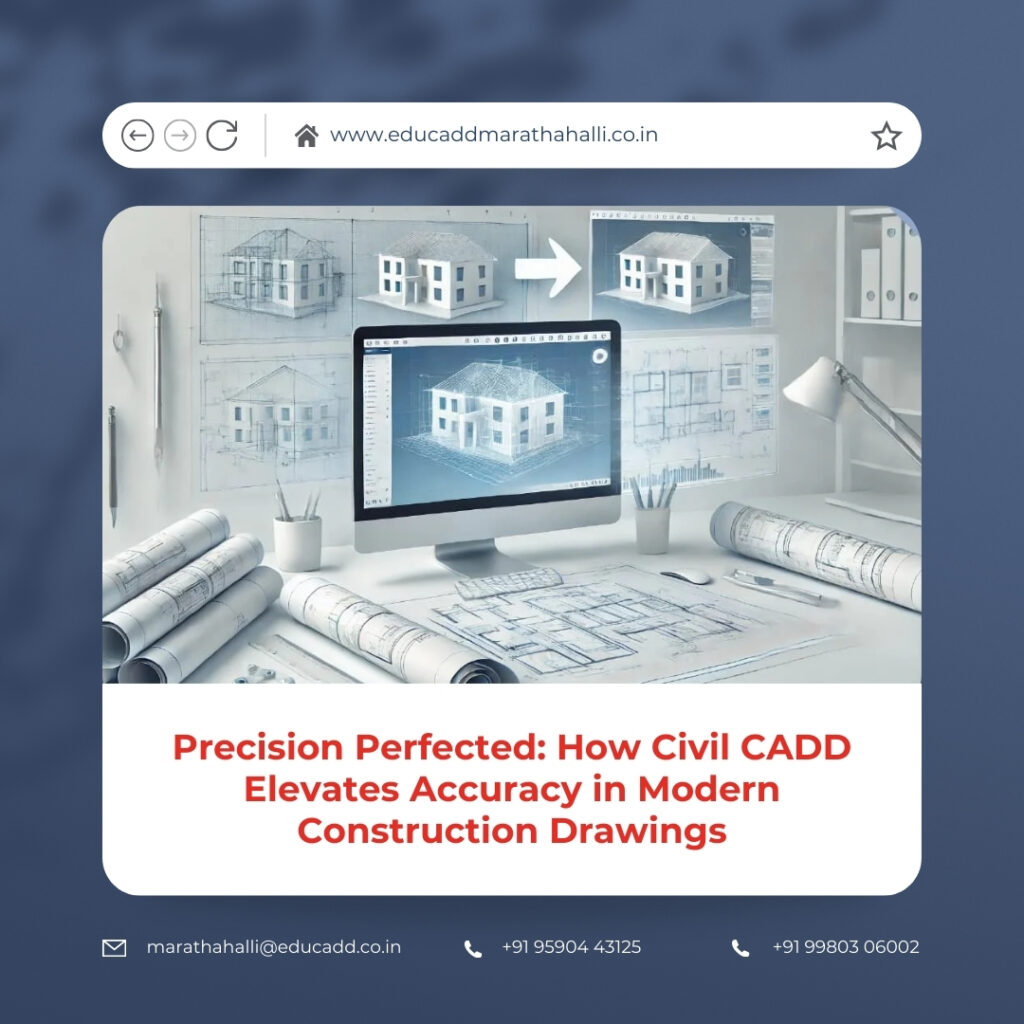
Civil CADD Drawing Accuracy
The following detailed discussion explores how Civil CADD enhances precision in construction drawings, reduces costly mistakes, strengthens collaboration, and supports long-term project success.
1. The Critical Role of Accuracy in Construction Documentation
Construction drawings serve as the technical language of a project. They communicate measurements, structural layouts, material specifications, levels, alignments, and installation guidelines. Contractors, engineers, supervisors, and clients rely on these documents to interpret design intent. If the drawings lack clarity or precision, misunderstandings occur. Those misunderstandings often translate into construction errors, resource wastage, and financial loss.
In traditional drafting systems, professionals depended heavily on manual calculations and hand-drawn layouts. Even experienced drafters occasionally introduced small discrepancies while scaling, measuring, or revising drawings. A minor dimensional inconsistency in a structural beam or column could result in serious site adjustments. Additionally, when revisions were made manually, updating every related drawing sheet became a time-consuming process. Missing one revision often created conflicts between plan, elevation, and section views.
Civil CADD addresses these challenges through digital accuracy. Every line, arc, and dimension follows coordinate-based mathematical precision. Instead of estimating or manually scaling components, designers input exact values. The software ensures that these values remain consistent throughout the project. By replacing manual drafting limitations with automated precision, Civil CADD significantly strengthens the reliability of construction documentation.
2. What Makes Civil CADD a Precision-Oriented Tool
Civil CADD Drawing Accuracy stands for Computer-Aided Design and Drafting specifically customized for civil engineering projects. Unlike general design software, Civil CADD includes tools tailored for site planning, infrastructure layouts, contour mapping, grading, road alignment, and utility design. This specialization makes it exceptionally effective for producing technically accurate construction drawings.
The software operates on a coordinate-based system. Designers define reference points and axes, ensuring that every element aligns perfectly with project parameters. Because the system uses precise numerical input rather than freehand drawing, geometric accuracy improves dramatically. Civil CADD also allows users to define units clearly, whether in millimeters, meters, or feet. This eliminates confusion during conversions and ensures consistent measurement standards across international projects.
Another important feature lies in parametric controls. When a designer modifies a structural component, associated dimensions and references update automatically. This intelligent responsiveness reduces the possibility of outdated measurements remaining on the drawing. As a result, Civil CADD becomes a proactive accuracy management system rather than just a drafting platform.
3. Automated Dimensioning and Dynamic Updates
One of the most powerful ways Civil CADD enhances accuracy is through automated dimensioning. In manual drafting, dimensions were written separately from the drawing lines. When changes occurred, drafters needed to revise those dimensions manually. Forgetting to update even one value could create confusion on-site.
Civil CADD eliminates that risk through associative dimensions. These dimensions link directly to drawing elements. When the length of a wall changes, the dimension updates instantly. This dynamic link ensures that numerical values always match the graphical representation. It also prevents contradictions between different drawing sheets.
Moreover, the software supports precise snapping tools. Designers can snap to exact endpoints, midpoints, intersections, and center points. These features ensure alignment accuracy. Instead of relying on visual approximation, professionals depend on mathematically exact placement. Automated scaling and alignment tools further enhance dimensional consistency.
Through intelligent automation, Civil CADD significantly reduces human intervention in measurement tasks, thereby minimizing the likelihood of calculation errors.
4. Structured Layer Management for Clarity and Control
Construction drawings often include multiple systems within a single project. Structural frameworks, plumbing layouts, electrical routing, HVAC systems, landscaping details, and drainage plans must coexist within coordinated documentation. Without structured organization, these overlapping components can cause confusion.
Civil CADD Drawing Accuracy introduces advanced layer management to solve this issue. Designers assign each system to a separate layer. For example, foundation details remain on one layer, reinforcement layouts on another, and utility lines on separate layers. This structure enables teams to view or hide specific elements as needed. Consequently, professionals can focus on one system without interference from others.
Layer properties also support predefined line types, thicknesses, and colors. These standardized visual cues help identify components quickly. More importantly, controlled layering prevents accidental modifications. Users can lock layers to protect critical design elements from unintended changes. This organized approach strengthens drafting accuracy and ensures that every component remains clearly defined.
5. Accurate Topographical Modeling and Site Integration
Site conditions significantly influence construction precision. Elevation levels, slopes, contours, and soil conditions determine foundation design and drainage planning. When survey data is misinterpreted or inaccurately drafted, construction teams face serious challenges.
Civil CADD allows direct integration of survey coordinates into the design environment. Survey points convert into digital terrain models that reflect real-world topography accurately. Engineers can generate contour maps automatically, ensuring that slopes and gradients align with site conditions.
Additionally, grading tools help calculate cut-and-fill volumes with high precision. Designers can simulate earthwork requirements before excavation begins. This proactive analysis prevents unexpected adjustments during construction. Drainage planning also benefits from accurate slope modeling, as water flow paths become clearly defined.
By integrating topographical data directly into construction drawings, Civil CADD ensures that designs match actual environmental conditions, thereby improving overall project reliability.
6. Clash Detection and Error Identification
In complex projects, conflicts between structural and utility systems often occur. For example, an underground pipeline may intersect with a footing, or an electrical conduit may pass through a load-bearing column. Identifying these issues during construction leads to delays and rework.
Civil CADD incorporates clash detection features that highlight overlapping elements. When two components occupy the same space, the system alerts the designer. This early detection allows corrections before final documentation.
Additionally, alignment checks verify geometric relationships. Horizontal and vertical alignments remain consistent across plan and elevation views. Annotation validation tools confirm that text labels correspond accurately to objects.
By identifying conflicts at the design stage, Civil CADD reduces the risk of costly on-site modifications. It strengthens quality assurance and supports smoother project execution.
7. Standardization and Compliance Assurance
Construction drawings must comply with industry standards and building regulations. Inconsistent formatting or missing details often result in approval delays. Civil CADD supports standardized templates that include title blocks, dimension styles, and annotation conventions aligned with professional guidelines.
Engineers can create reusable templates for recurring project types. This consistency ensures uniform documentation across multiple projects. Additionally, predefined drafting standards reduce ambiguity in line types, symbols, and measurement formats.
Compliance checks also support structural accuracy. Designers can verify load distribution calculations and alignment parameters digitally. This integration enhances confidence during regulatory reviews.
By promoting standardized documentation practices, Civil CADD strengthens the credibility and acceptance of construction drawings.
8. Real-Time Collaboration and Coordination
Modern construction projects involve multidisciplinary teams working simultaneously. Miscommunication between departments often leads to inconsistent drawings. Civil CADD supports collaborative workflows that improve coordination.
Digital file sharing enables real-time updates. When one team revises a component, others can access the updated version immediately. This synchronization reduces outdated references and duplication of effort.
Version control systems track revisions systematically. Teams can review change histories and maintain accountability. Clear coordination ensures that structural, architectural, and service layouts align accurately.
Through collaborative precision, Civil CADD reduces communication gaps and strengthens overall drawing accuracy.
9. 3D Visualization and Spatial Clarity
Two-dimensional drawings sometimes limit spatial understanding. Civil CADD Drawing Accuracy through three-dimensional modeling capabilities. Engineers can convert 2D plans into realistic 3D representations.
Three-dimensional visualization reveals potential spatial conflicts that flat drawings might overlook. Designers can examine structural relationships, clearance spaces, and elevation differences more effectively.
Clients and contractors also benefit from improved visualization. Clear representations reduce misinterpretation and ensure alignment with design intent. Enhanced spatial awareness ultimately supports higher accuracy during construction execution.
10. Time Efficiency and Reduced Rework
Accuracy directly impacts project timelines. When drawings contain errors, corrections consume additional time and resources. Civil CADD streamlines drafting tasks through automation and reusable components.
Copy, mirror, and array functions replicate design elements with exact precision. Instead of redrawing similar components repeatedly, designers maintain uniformity efficiently. Automated annotation tools accelerate documentation without compromising accuracy.
Because revisions update dynamically, teams avoid repetitive corrections. This efficiency shortens design cycles and minimizes rework during construction.
11. Integration with Advanced Construction Technologies
Construction management increasingly relies on digital ecosystems. Civil CADD integrates smoothly with Building Information Modeling systems and project management platforms. This integration connects design accuracy with scheduling and budgeting tools.
Quantities extracted from precise drawings inform cost estimations. Accurate data supports financial planning and procurement decisions. Additionally, exporting data into project management software maintains alignment between design and execution.
By linking drafting precision with operational planning, Civil CADD strengthens project transparency and accountability.
12. Strengthening Quality Control Processes
Quality control ensures that construction drawings meet technical expectations. Civil CADD supports structured review workflows. Supervisors can mark up drawings digitally and provide clear feedback.
Scaling tools verify proportional accuracy. Grid systems confirm alignment consistency. Through systematic review procedures, design teams detect minor discrepancies before final submission.
This structured approach reinforces drawing reliability and enhances professional standards.
13. Applications Across Diverse Infrastructure Projects
Civil CADD proves valuable across various project categories. In highway design, alignment tools ensure smooth curvature transitions. In bridge construction, structural detailing maintains dimensional precision. Residential projects benefit from accurate floor layouts and service coordination.
Utility planning also gains accuracy through precise pipe routing and slope calculations. Regardless of project scale, Civil CADD adapts to requirements while maintaining consistent documentation standards.
Its versatility demonstrates its significance in modern civil engineering practice.
14. Long-Term Impact on Project Success
Accurate construction drawings influence every project phase, from planning to maintenance. When documentation remains precise, contractors execute tasks confidently. Clients experience fewer budget fluctuations and timeline disruptions.
Civil CADD fosters trust between stakeholders by delivering dependable documentation. Reduced rework enhances profitability. Improved coordination strengthens safety compliance. Over time, organizations that adopt Civil CADD establish reputations for reliability and technical excellence.
Conclusion
Precision defines construction excellence. As projects grow increasingly sophisticated, digital accuracy becomes essential. Civil CADD Drawing Accuracy from a manual, error-prone activity into a data-driven process grounded in mathematical precision. Through automated dimensioning, structured layering, clash detection, topographical integration, and collaborative workflows, it elevates the quality of construction documentation.
By minimizing human error and enhancing coordination, Civil CADD ensures that drawings reflect true design intent and real-world conditions. Organizations that embrace this technology position themselves for sustainable growth and competitive advantage. In a field where even small inaccuracies can lead to major consequences, Civil CADD stands as a powerful instrument for delivering clarity, confidence, and construction success.

