
From Physical Parts to Precision Models: Mastering Reverse Engineering with 3D Scanning Technology
Reverse Engineering 3D Scanning move at an incredible pace. Products evolve faster, customer expectations rise higher, and competition grows stronger each year. In this dynamic environment, companies must innovate continuously while maintaining accuracy and efficiency. One powerful method that supports this transformation is reverse engineering with 3D scanning technology. This advanced approach allows professionals to convert real-world objects into accurate digital models for redesign, analysis, and manufacturing. Instead of starting from scratch, engineers capture existing components and rebuild them intelligently in a digital environment.
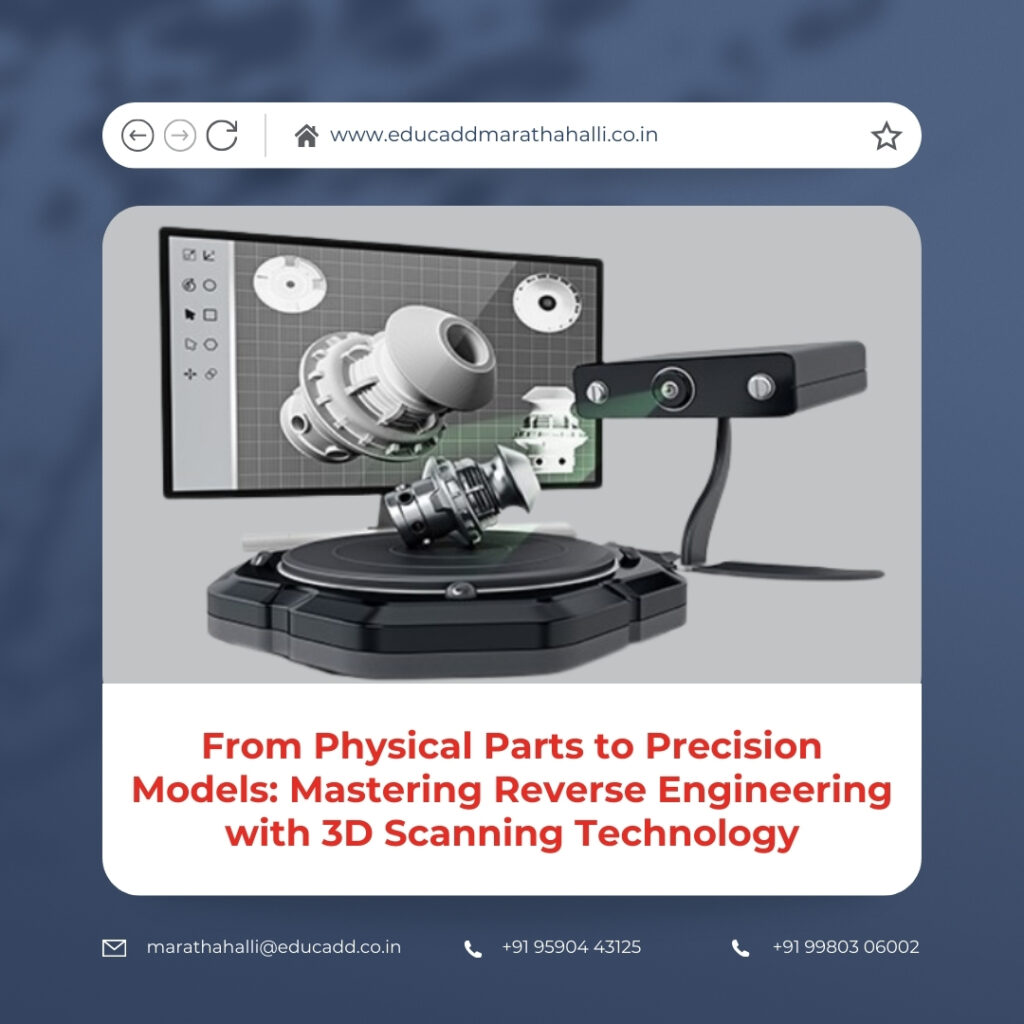
Reverse Engineering 3D Scanning
Reverse Engineering 3D Scanning has become a cornerstone of digital manufacturing and product development. It combines hardware precision with software intelligence, enabling engineers to recreate complex geometries with remarkable detail. As industries adopt automation, additive manufacturing, and smart production systems, this skill continues to gain importance. Learning reverse engineering with 3D scanning technology today means preparing for a future driven by innovation and digital transformation.
1. What Reverse Engineering with 3D Scanning Technology Really Means
Reverse engineering with 3D scanning technology refers to the structured process of analyzing a physical object and transforming it into a digital 3D model. Instead of relying on original blueprints, professionals capture the geometry of an existing component and rebuild it using CAD software. This process proves essential when original design files are missing, outdated, or incomplete.
The workflow begins with scanning the object using advanced devices that capture millions of surface points. These points form a digital representation known as a point cloud. Next, specialized software converts the point cloud into a mesh surface. Finally, engineers create a fully editable parametric model from that mesh. Through reverse engineering with 3D scanning technology, complex shapes become measurable, modifiable, and ready for further development.
This method not only saves time but also improves accuracy. As a result, industries across the globe rely on reverse engineering with 3D scanning technology to maintain production efficiency and product quality.
2. Why Modern Industries Depend on This Approach
Companies prefer reverse engineering with 3D scanning technology because it delivers speed, precision, and flexibility. Traditional measurement techniques require manual tools, repeated calculations, and detailed drafting. In contrast, 3D scanning captures intricate shapes quickly and accurately.
For example, manufacturing plants often face challenges when older machinery components wear out. Without original drawings, recreating the part manually becomes difficult. However, reverse engineering with 3D scanning technology allows engineers to scan the damaged component and produce a digital model within hours. Production can then resume with minimal downtime.
Additionally, product development teams analyze competitor products to understand design strategies and material usage. By scanning components and studying their structure, companies gain insights that support innovation. Therefore, reverse engineering with 3D scanning technology strengthens competitive advantage and accelerates product improvement.
3. Step-by-Step Workflow Explained Clearly
To understand reverse engineering with 3D scanning technology thoroughly, it is important to examine each stage carefully. The process follows a logical sequence that ensures reliable outcomes.
First, professionals prepare the object for scanning. They clean the surface, remove reflective materials, and apply markers if required. Proper preparation improves scanning accuracy. Next, they use handheld or fixed scanners to capture surface data from multiple angles.
After data collection, they import the scan into processing software. At this stage, technicians remove noise, align multiple scans, and generate a unified point cloud. The software then converts this cloud into a mesh model. Finally, engineers reconstruct the geometry into a parametric CAD model suitable for editing, analysis, and manufacturing.
Each phase in reverse engineering with 3D scanning technology requires attention to detail. However, once mastered, the workflow becomes efficient and repeatable.
4. Essential Tools and Software Platforms
Reverse engineering with 3D scanning technology depends on advanced tools that ensure precision and reliability. High-quality scanners form the foundation of the process. Laser scanners project beams across surfaces to measure geometry accurately. Structured light scanners use projected patterns to capture fine details.
Equally important is the software environment. Applications such as Geomagic, PolyWorks, and SolidWorks help convert raw scan data into usable models. These programs allow professionals to refine meshes, extract features, and create parametric designs.
Moreover, inspection software compares the reconstructed model with the original component to verify dimensional accuracy. Learning reverse engineering with 3D scanning technology involves gaining hands-on experience with these tools, which significantly enhances technical competence.
5. Applications Across Multiple Industries
Reverse engineering with 3D scanning technology plays a vital role in diverse industries. In automotive manufacturing, engineers scan engine parts, body panels, and interior components for redesign and optimization. This approach reduces development cycles and improves performance.
In aerospace engineering, precision remains critical. Professionals use reverse engineering with 3D scanning technology to analyze turbine blades, structural brackets, and aerodynamic components. The digital models support simulation and stress analysis.
Healthcare also benefits greatly. Medical experts design customized prosthetics and implants based on scanned body parts. Additionally, cultural preservation teams digitize historical artifacts to create accurate replicas. These varied applications demonstrate the versatility of reverse engineering with 3D scanning technology.
6. Advantages of Developing This Skill
Learning Reverse Engineering 3D Scanning offers numerous professional benefits. First, it increases employability in advanced manufacturing and engineering sectors. Companies actively seek individuals who understand scanning workflows and CAD reconstruction.
Second, the skill enhances analytical thinking. Professionals learn to interpret complex geometries and convert them into structured digital models. This process strengthens problem-solving capabilities.
Furthermore, reverse engineering with 3D scanning technology supports entrepreneurial opportunities. Skilled professionals can offer scanning and modeling services to industries that lack in-house expertise. Consequently, this knowledge creates multiple career pathways.
7. Technical Competencies Required for Success
To excel in reverse engineering with 3D scanning technology, individuals must develop strong technical foundations. Proficiency in CAD software remains essential. Understanding surface modeling, parametric design, and geometric dimensioning improves reconstruction accuracy.
In addition, knowledge of measurement principles ensures precise scanning results. Attention to detail helps identify irregularities and refine models effectively. Collaboration skills also play an important role, as reverse engineering projects often involve multidisciplinary teams.
By cultivating these competencies, professionals can perform reverse engineering with 3D scanning technology confidently and efficiently.
8. Common Challenges and Practical Solutions
Although reverse engineering with 3D scanning technology offers many advantages, certain challenges may arise. Complex surfaces sometimes generate incomplete scan data. Reflective materials may interfere with light-based scanning systems.
However, proper techniques reduce these issues significantly. Professionals use matte sprays to minimize reflections and capture clearer data. Advanced filtering tools remove noise and fill gaps in the mesh.
With consistent practice, these challenges become manageable. Therefore, reverse engineering with 3D scanning technology becomes more effective as experience grows.
9. Growing Career Opportunities Worldwide
The demand for reverse engineering with 3D scanning technology continues to expand globally. Manufacturing companies require specialists who can digitize components quickly. Engineering consultancies rely on scanning experts for product validation and redesign projects.
Additive manufacturing startups also depend on accurate digital models created through reverse engineering with 3D scanning technology. As Industry 4.0 initiatives gain momentum, digital modeling skills become even more valuable.
This increasing demand ensures strong career prospects for professionals who invest in mastering this field.
10. Structured Training and Certification Pathways
Professional training programs provide systematic learning in reverse engineering with 3D scanning technology. Courses typically cover scanning fundamentals, mesh processing, CAD reconstruction, and inspection techniques. Practical projects allow learners to apply concepts in real scenarios.
Certification strengthens credibility and demonstrates industry readiness. Employers often prefer certified professionals because they bring validated skills to the workplace.
By enrolling in structured programs, learners accelerate their journey toward expertise in reverse engineering with 3D scanning technology.
11. Integration with Additive Manufacturing and Digital Twins
Reverse engineering with 3D scanning technology integrates seamlessly with emerging technologies. For instance, scanned models serve as input for 3D printing systems. Engineers can reproduce obsolete parts quickly using additive manufacturing.
Digital twin technology also benefits from accurate scan data. Companies create virtual replicas of physical assets for monitoring and predictive maintenance. Artificial intelligence tools further enhance data processing and feature recognition.
As innovation advances, reverse engineering with 3D scanning technology remains at the center of digital transformation initiatives.
12. Real-World Project Execution Strategies
Successful implementation of reverse engineering with 3D scanning technology requires structured planning. Professionals define project objectives clearly before scanning begins. They determine accuracy requirements and select appropriate scanning equipment.
After reconstruction, engineers validate the model through inspection comparisons. They refine geometry and optimize design features if necessary. This disciplined approach ensures reliable outcomes and industry compliance.
Hands-on experience with real projects strengthens confidence and prepares professionals for complex assignments.
13. Future Trends and Technological Evolution
The future of reverse engineering with 3D scanning technology looks exceptionally promising. Smart factories increasingly rely on digital models for automation and robotic integration. Sustainability initiatives encourage part refurbishment instead of replacement, and scanning supports this objective effectively.
Furthermore, advancements in portable scanning devices and AI-driven software improve efficiency and accessibility. As technology evolves, reverse engineering with 3D scanning technology will continue to expand into new domains and applications.
Professionals who adapt to these trends will remain highly valuable in the evolving engineering landscape.
14. Take the First Step Toward Mastery
Now is the perfect time to begin learning reverse engineering with 3D scanning technology. The field combines engineering knowledge, digital modeling skills, and innovative problem-solving. Through structured training and consistent practice, you can develop expertise that aligns with modern industry requirements.
By mastering reverse engineering with 3D scanning technology, you position yourself for a dynamic and rewarding career. The ability to transform physical components into intelligent digital assets represents a powerful capability in today’s competitive world. Start building your skills today and become a part of the digital engineering revolution.
Conclusion
Reverse Engineering 3D Scanning has redefined how industries approach design, analysis, and manufacturing. It bridges the gap between the physical and digital worlds, enabling accurate reconstruction and continuous innovation. From automotive and aerospace to healthcare and heritage preservation, its applications continue to grow rapidly.
As industries embrace digital transformation, professionals skilled in reverse engineering with 3D scanning technology will remain in high demand. By investing in structured learning and practical experience, you can secure a strong position in this evolving field. Embrace the opportunity, develop your expertise, and shape the future of engineering with confidence.

