
From Digital Blueprints to the Sky: How CAD for Aerospace Components Builds Elite Engineering Careers
Modern aerospace engineering thrives on accuracy, innovation, and uncompromising safety standards. Every aircraft, satellite, or spacecraft begins its journey as a digital concept long before it takes physical form. At the heart of this transformation lies CAD Aerospace Engineering Careers, a discipline that converts engineering vision into precise, manufacturable designs. As aerospace systems grow more advanced, the reliance on CAD has shifted from supportive technology to a core industry requirement.
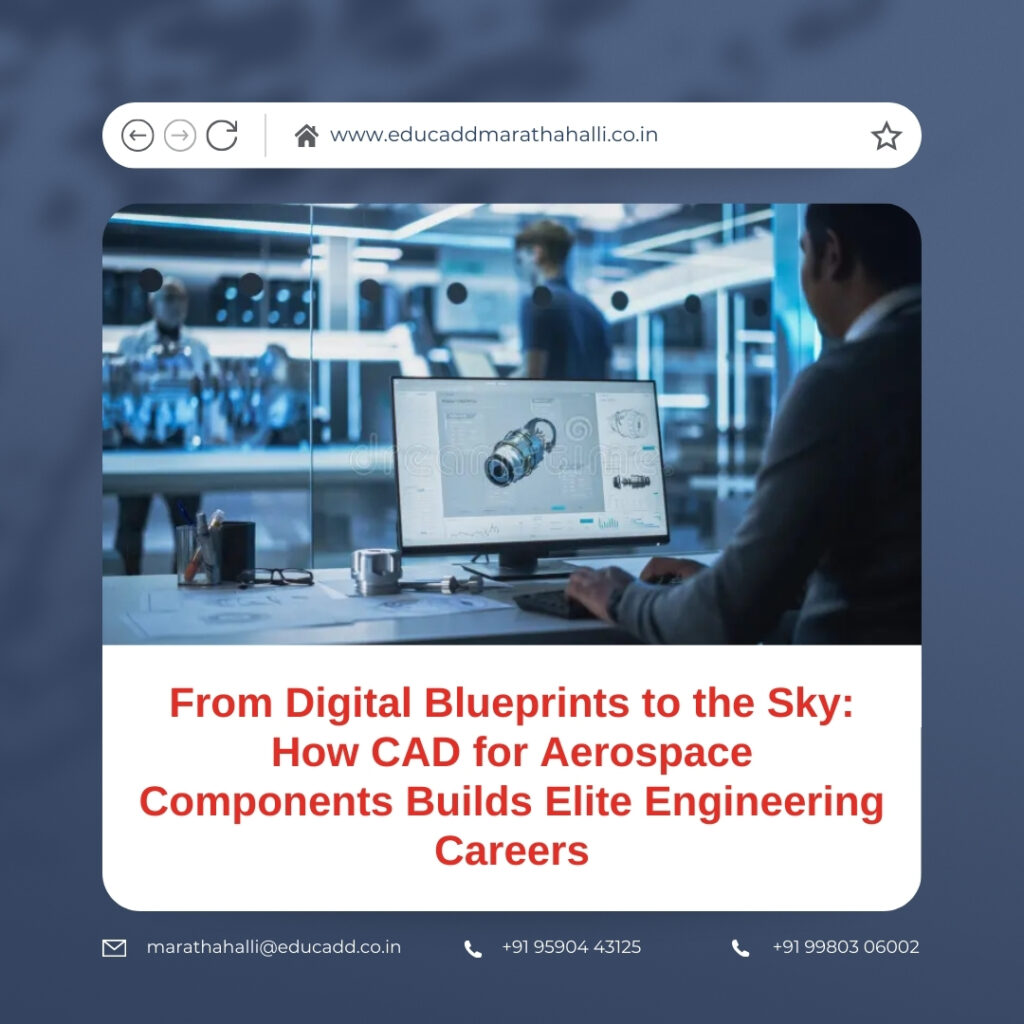
CAD Aerospace Engineering Careers
Today’s aerospace professionals must design lighter structures, withstand extreme operating conditions, and comply with strict global regulations. CAD tools make this possible by enabling engineers to visualize, test, and refine components in a virtual environment. More importantly, mastery of aerospace CAD has become a direct pathway to high-tech, future-proof careers. This blog explores how CAD drives aerospace innovation, the tools and skills involved, and why it has become a powerful career accelerator.
1. The Role of CAD in Aerospace Component Design
CAD Aerospace Engineering Careers plays a foundational role in how modern aircraft and space systems are engineered. Unlike basic mechanical design, aerospace CAD focuses on high-precision geometry, complex assemblies, and performance-driven structures. Every component must function flawlessly under intense pressure, vibration, and temperature changes.
Engineers use CAD software to create three-dimensional models that represent real-world behavior. These models define the shape, dimensions, tolerances, and material properties of each part. As a result, designers can identify potential issues early in the development cycle. This proactive approach saves time, reduces cost, and enhances safety.
Another critical aspect lies in integration. Aerospace components rarely function in isolation. Wings, fuselage frames, propulsion systems, and avionics must work together seamlessly. CAD allows engineers to assemble thousands of parts digitally and test their interaction. Therefore, alignment problems and interference issues get resolved before manufacturing begins.
Furthermore, CAD supports design optimization. Engineers analyze stress distribution and material usage directly within the model. This capability helps reduce weight while maintaining strength. Since weight directly affects fuel efficiency and performance, CAD-driven optimization becomes a competitive advantage.
Through these capabilities, CAD for aerospace components transforms ideas into reliable, high-performance designs that meet industry expectations.
2. Why Aerospace Engineering Depends on Advanced CAD Systems
The aerospace industry operates under some of the strictest quality and safety regulations in the world. CAD systems help engineers meet these demands consistently. By maintaining accuracy and repeatability, CAD ensures that every component adheres to defined specifications.
One major advantage of CAD lies in error reduction. Manual drafting increases the risk of dimensional inaccuracies. CAD eliminates this risk by using parametric modeling. When engineers modify one dimension, related features update automatically. Consequently, design consistency remains intact throughout revisions.
CAD also supports compliance and certification. Aerospace authorities require detailed documentation for every component. CAD models generate precise drawings, part lists, and digital records. These outputs simplify audits and regulatory reviews.
Additionally, CAD improves collaboration across departments. Design teams, analysts, and manufacturers work from a single digital source. This shared environment reduces miscommunication and accelerates decision-making. As a result, development timelines become more predictable.
Because of these benefits, aerospace companies invest heavily in advanced CAD platforms. Professionals who master these systems become indispensable assets within engineering teams.
3. Industry-Standard CAD Tools in Aerospace Applications
Several specialized CAD tools dominate aerospace design due to their ability to handle complexity and scale. Each platform serves specific needs across the product lifecycle.
CATIA stands as a leading choice for large aerospace manufacturers. It excels in surface modeling and complex assemblies. Aircraft structures with intricate curves rely heavily on its advanced geometry capabilities. Engineers use it to manage massive datasets efficiently.
Siemens NX offers an integrated environment that combines CAD, simulation, and manufacturing. This integration supports seamless transitions from design to production. Aerospace companies value NX for its ability to manage digital continuity.
SolidWorks remains popular among suppliers and component manufacturers. It supports rapid prototyping and detailed part design. Although it serves multiple industries, its precision makes it suitable for aerospace applications as well.
PTC Creo and Autodesk Fusion also contribute to aerospace workflows. These tools support parametric design and cloud-based collaboration. Their flexibility helps teams iterate designs quickly.
Proficiency in these tools significantly enhances employability. Employers prioritize candidates who adapt easily to their preferred platforms. Therefore, exposure to industry-standard software strengthens career readiness in aerospace CAD roles.
4. High-Tech Career Paths Enabled by Aerospace CAD Expertise
Mastering CAD for aerospace components opens doors to a wide range of specialized careers. These roles extend beyond traditional design positions and span multiple sectors.
CAD Aerospace Engineering Careers focus on creating detailed models for aerospace parts. They collaborate with analysts to ensure structural integrity and manufacturability. Structural designers specialize in load-bearing components that support safety-critical systems.
Tooling and manufacturing engineers rely on CAD to design fixtures, molds, and assembly tools. Their work ensures efficient and accurate production. In research and development, CAD professionals explore innovative materials and configurations.
The defense and space sectors also offer strong opportunities. Satellite manufacturers, launch vehicle companies, and drone developers require skilled CAD designers. With private space exploration gaining momentum, demand continues to rise.
In addition, aerospace CAD skills support global freelancing and consulting opportunities. Experienced professionals contribute to international projects remotely. This flexibility enhances career longevity and income potential.
Overall, CAD expertise positions professionals for stable, high-growth careers within advanced engineering environments.
5. Building the Right Skill Set for Aerospace CAD Careers
A successful aerospace CAD career requires more than software knowledge. Professionals must develop a balanced skill set that combines technical understanding with practical application.
Engineering fundamentals form the base. Knowledge of materials, mechanics, and aerodynamics improves design quality. Without this foundation, CAD models lack functional reliability.
Next, understanding aerospace standards proves essential. Familiarity with GD&T, tolerance analysis, and certification requirements ensures compliance. These skills distinguish aerospace designers from general CAD users.
Hands-on experience accelerates learning. Real-world projects, internships, and simulations build confidence. They also demonstrate problem-solving ability to employers.
Continuous upskilling remains important as technology evolves. Advanced topics such as digital twins, simulation integration, and model-based definition increase career resilience. Professionals who adapt stay competitive.
By following this structured path, aspiring designers prepare themselves for demanding and rewarding aerospace roles.
Conclusion
CAD Aerospace Engineering Careers has reshaped how aircraft and space systems are designed, tested, and manufactured. It bridges creativity with precision and innovation with safety. As aerospace technology advances, CAD expertise continues to gain strategic importance.
For aspiring engineers and designers, CAD offers a clear route into high-tech, future-ready careers. Those who invest in aerospace-focused CAD skills position themselves at the forefront of engineering innovation. With continuous learning and practical exposure, CAD professionals contribute directly to shaping the future of flight and space exploration.

