
Blueprints to Breakthroughs: Master Rapid Prototyping Using CAD at EduCADD
The pace of innovation is accelerating, and industries now expect ideas to evolve into functional models faster than ever before. This demand highlights the importance of Rapid Prototyping Using CAD, a skill that blends creativity with precision. Whether you aim to advance in engineering, product development, manufacturing, or design, understanding how to build prototypes with CAD tools unlocks new professional possibilities.
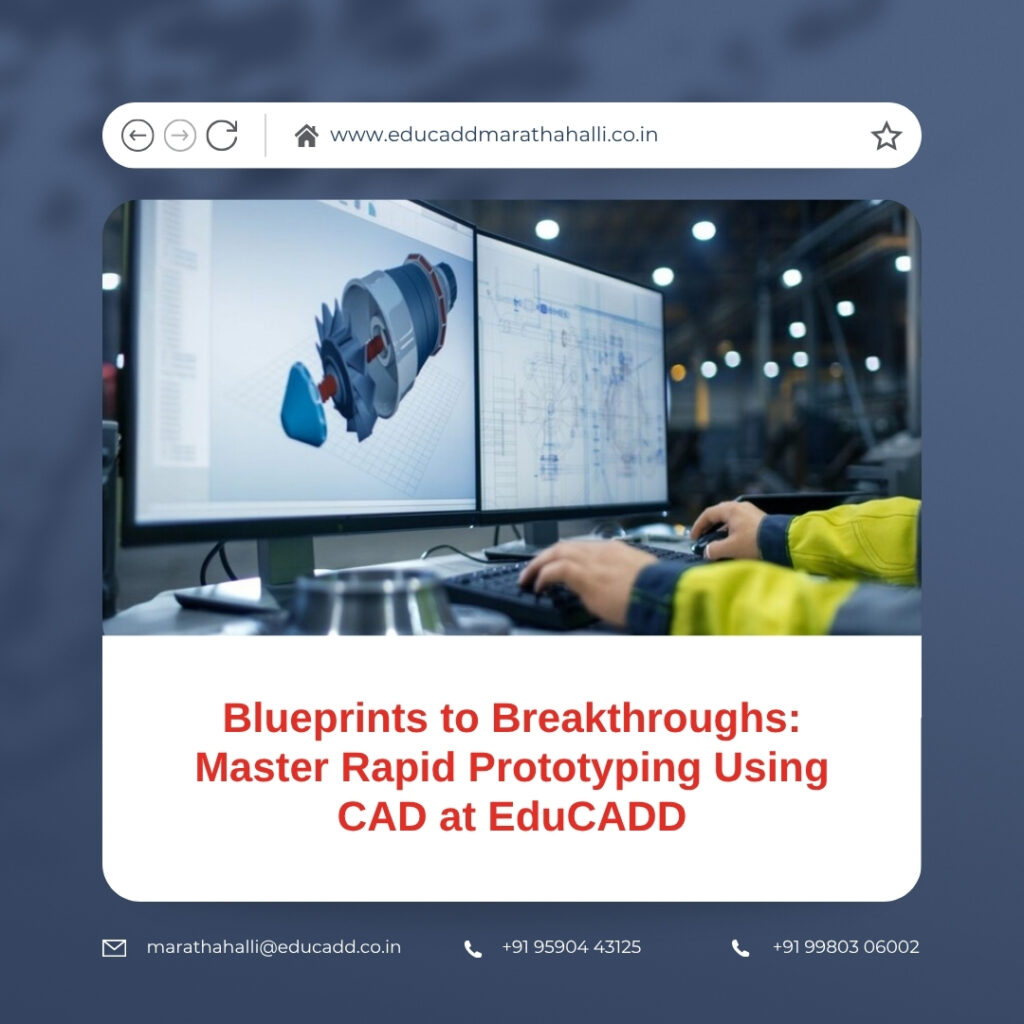
Rapid Prototyping Using CAD
EduCADD offers training that reflects real industry environments, giving learners the ability to transform concepts into accurate digital and physical models. This blog explores how mastering Rapid Prototyping Using CAD at EduCADD helps learners stand out in today’s competitive landscape and prepares them for future technological growth.
1. The New Age of Prototyping and Why Speed Matters
Prototyping has evolved into one of the most influential stages in product development. In earlier decades, prototypes required long timelines, expensive materials, and extensive revisions. Today, industries can no longer afford slow development cycles. Competitive markets demand rapid improvements, quicker product launches, and better design accuracy. This is where Rapid Prototyping Using CAD becomes essential, enabling engineers and designers to convert raw ideas into structured digital models at remarkable speed.
Modern consumers expect faster updates, customizable options, and seamless performance. Because of these expectations, companies rely on quicker design iterations. CAD-driven prototyping allows teams to examine concepts early in the process and make corrections before manufacturing. This creates a more agile workflow where designers explore multiple ideas without delay.
Speed is not the only benefit. Rapid prototyping improves decision-making by giving teams a clear view of form, structure, and functionality. With accurate digital models, designers can identify problems immediately and adjust designs before they become expensive mistakes. This reduces wasted time, cuts overall cost, and streamlines product refinement.
EduCADD recognizes these industry expectations. Their training introduces students to practical workflows used across engineering fields. Learners study how Rapid Prototyping Using CAD fits into real development pipelines and how companies use it to reduce risks and accelerate innovation. This knowledge equips students to enter the workforce with confidence and strong technical competence.
2. How CAD Accelerates Design, Innovation, and Testing
Computer-Aided Design has become the backbone of modern engineering. CAD software gives designers full control over every dimension, angle, and detail. When applied to rapid prototyping, its capabilities expand even further. Rapid Prototyping Using CAD combines digital modeling with hands-on testing, allowing ideas to move through the design cycle faster and more accurately.
One major advantage of CAD is precision. Designers visualize their concepts from multiple views, analyze structures, and define exact measurements. This eliminates guesswork and ensures that every feature serves a purpose. Parametric modeling further enhances this precision. When one measurement changes, linked components update automatically. This creates faster iterations and saves hours of manual editing.
Simulation tools also play a vital role. Instead of waiting for physical prototypes, designers run stress tests, motion simulations, and performance evaluations in the CAD environment. These digital checks reveal flaws quickly and allow improvements long before production begins. This leads to better durability, improved function, and greater reliability.
Another benefit is communication. Clear CAD models help teams understand the design without confusion. Engineers, managers, and manufacturers follow the same visual data, reducing misinterpretations. Many industries now use CAD models directly with 3D printers or CNC machines, ensuring accuracy from the digital stage to the physical prototype.
EduCADD integrates these advanced features into its curriculum. Students explore everything from basic sketching to surface modeling, assembly creation, design optimization, and simulation. They learn efficient workflows, industry shortcuts, and practical design strategies. This training prepares learners to navigate complex design challenges with ease and deliver professional-quality models.
3. Industry Demand for Rapid Prototyping Using CAD
Industries across the world rely heavily on rapid prototyping because it shortens the journey from idea to market. Sectors such as automotive, robotics, aerospace, consumer electronics, architecture, and industrial machinery all depend on professionals skilled in Rapid Prototyping Using CAD. These industries need people who design with speed, detail, and precision.
Companies adopt rapid prototyping for several reasons. First, it reduces manufacturing risks. Digital models reveal problems early, making corrections easier and cheaper. Second, it helps teams evaluate multiple design variations quickly. When trying to improve performance or efficiency, rapid iterations lead to better outcomes.
Customization has also become a major trend. Many clients expect tailored solutions, and CAD makes this possible by simplifying model adjustments. Whether it is customizing dimensions, modifying components, or changing aesthetics, CAD tools support quick and accurate personalization.
Sustainability is another aspect. Digital modeling reduces material waste because fewer physical prototypes are needed. This aligns with global environmental goals while cutting project costs. CAD-based prototyping also supports clever resource management by allowing designers to test alternatives without producing unnecessary samples.
EduCADD gives students a strong understanding of these industry needs. The training covers real scenarios where Rapid Prototyping Using CAD solves design challenges, improves efficiency, and supports innovation. By working on practical projects, students learn to think like professionals who deliver smart and reliable solutions.
4. EduCADD’s Skill-Building Approach to Mastering CAD
EduCADD’s training focuses on developing practical skills that match industry standards. The program covers all stages of Rapid Prototyping Using CAD, starting with the basics and progressing into advanced modeling techniques. Every student learns to build accurate sketches, apply constraints, design 3D models, and assemble components into complete systems.
Practical learning defines the EduCADD experience. Students work with leading CAD tools used by engineering companies around the world. They learn how to convert early concepts into structured prototypes and understand the logic behind effective design. Every exercise encourages problem-solving, creativity, and technical precision.
Real-world application is emphasized throughout the course. Students practice handling complex shapes, engineering principles, tolerance requirements, and optimization methods. They also learn how different components interact, which helps them build models suitable for actual manufacturing.
EduCADD also teaches how to prepare documentation and communicate design intent clearly. Engineers must share their work with clients, manufacturers, and team members, and strong documentation skills make this process smoother. Learners understand industry standards and how to present their ideas professionally.
By the end of the program, students gain strong technical foundations and hands-on experience. They feel confident creating prototypes, evaluating design performance, and assisting in product development processes. This combination of theory and practice makes EduCADD graduates highly capable and job-ready.
5. Career Growth and the Future of CAD-Driven Prototyping
The demand for professionals skilled in Rapid Prototyping Using CAD is rising across global industries. Every company working with product design or engineering relies on CAD expertise to stay competitive. As a result, roles such as CAD Engineer, Product Designer, Mechanical Draftsman, Prototype Specialist, and Development Engineer offer excellent career opportunities.
Modern manufacturing continues to embrace digital tools. With the rising use of 3D printing, additive manufacturing, AI-supported modeling, and cloud-based collaboration, the future of rapid prototyping looks even more promising. These innovations enable faster workflows, smarter designs, and greater accuracy.
Professionals who understand CAD will always have an advantage. They help organizations bring ideas to life with speed and precision. They also contribute to research, innovation, and product improvement. This skill is valuable in both established industries and emerging technology fields.
EduCADD prepares students for this evolving future. The training provides strong technical exposure and project experience that employers recognize. Learners graduate with portfolios that demonstrate their ability to design efficiently, solve problems creatively, and support real product development cycles. This positions them as valuable contributors to industry progress.
Conclusion
Rapid Prototyping Using CAD has become an essential skill in today’s fast-paced engineering and design world. It empowers students and professionals to convert ideas into functional models with unmatched accuracy and speed. As industries continue to innovate, the ability to design, test, and refine prototypes quickly becomes a major competitive advantage.
EduCADD offers training that reflects real industry practices. Through hands-on learning, expert guidance, and advanced CAD tools, students gain the confidence to create high-quality prototypes and optimized designs. They develop a strong foundation that supports long-term career growth and prepares them for diverse opportunities in manufacturing, automotive, aerospace, product design, and more.
Mastering Rapid Prototyping Using CAD at EduCADD is not just about learning software—it is about developing a skill set that fuels innovation, creativity, and professional success. It gives learners the tools to shape the future of engineering and play an active role in building smarter, faster, and more efficient products. This makes the journey not only rewarding but also a powerful step toward long-term career achievement.

