
Transforming Ideas into Structures: Real-Life BIM Projects You’ll Experience at EduCADD
EduCADD’s training philosophy is simple yet powerful: learn by doing. Instead of restricting students to software commands, the institute immerses them in Real Life BIM Projects that mirror the actual challenges faced by architects, engineers, and construction professionals. Each project teaches students how to plan, design, visualize, and execute models that respond to real-world constraints.
However, mastering BIM goes far beyond understanding its theory. It requires hands-on experience — the ability to handle complex design problems, coordinate across disciplines, and simulate real construction workflows. That’s exactly what EduCADD provides.
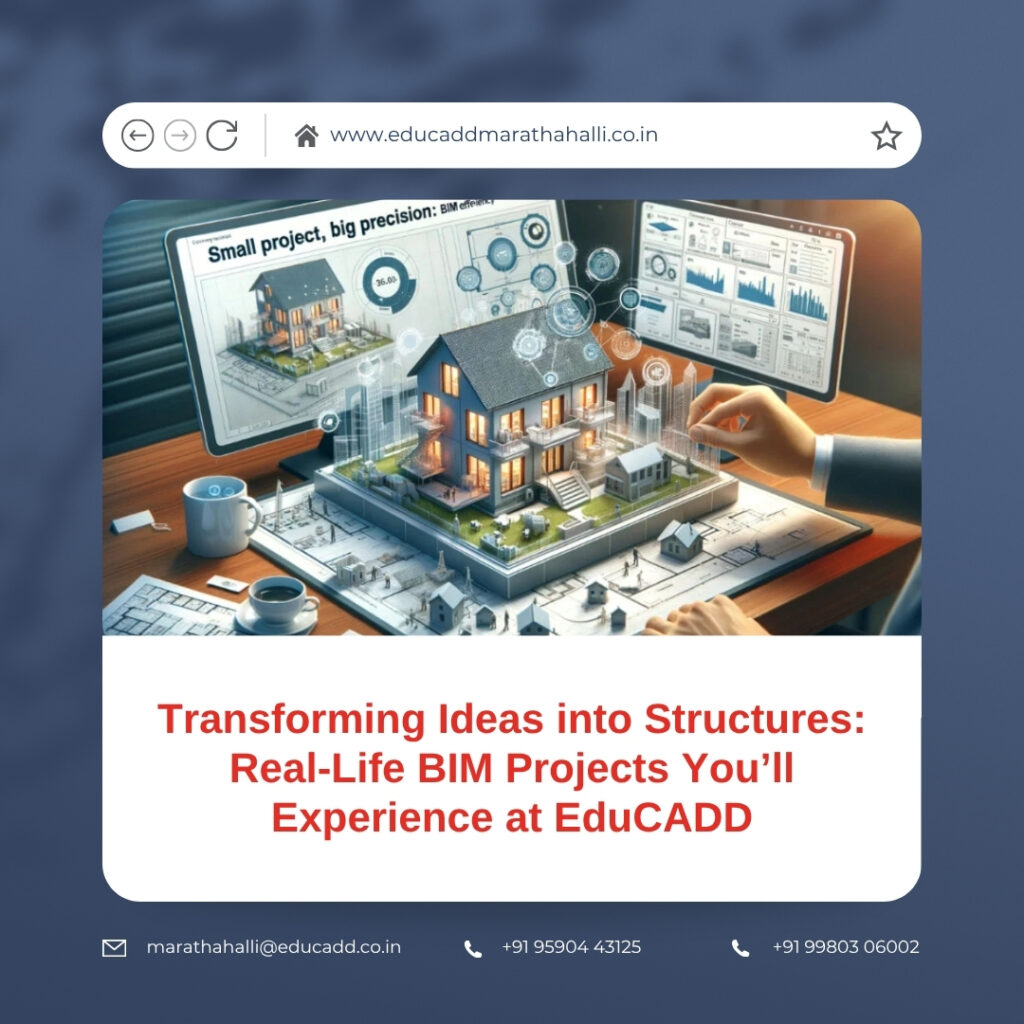
Real Life BIM Projects
In the fast-paced world of modern construction and architecture, digital transformation has become the foundation for innovation. Among the most impactful advancements is Building Information Modeling (BIM) — a revolutionary process that integrates technology, collaboration, and intelligent data into every phase of construction.
By the time learners complete the course, they aren’t just familiar with tools like Autodesk Revit, Navisworks, and AutoCAD — they’ve already applied them to solve genuine design and coordination problems. Let’s explore how EduCADD helps you build confidence and skill through a series of realistic BIM project experiences.
1. What Makes BIM the Backbone of Modern Construction
To appreciate the power of BIM, it’s essential to understand its purpose. Building Information Modeling is not merely about 3D modeling — it’s about data-driven collaboration. It creates a single intelligent digital model that holds every piece of information related to a building — geometry, materials, cost, scheduling, and maintenance details.
Traditionally, construction teams operated in silos. Architects designed, engineers calculated, and contractors built — often without seamless coordination. This lack of collaboration led to costly mistakes, project delays, and design conflicts. BIM removes these barriers by enabling every stakeholder to work within the same digital environment.
EduCADD introduces students to this transformative methodology from day one. The curriculum starts with conceptual modeling and parametric design, helping learners understand how digital elements behave and interact. Students discover how to link time (4D) and cost (5D) data to physical components, producing a model that evolves with every project phase.
Moreover, EduCADD’s instructors emphasize interdisciplinary communication — showing how architects, structural engineers, and MEP experts collaborate using shared models. This approach prepares students for the realities of modern project environments, where BIM is no longer optional but essential for efficiency, accuracy, and sustainability.
By mastering these principles early on, learners are ready to tackle complex real-life BIM projects with clarity and confidence.
2. Project 1: Smart Residential Design — Laying the Foundation
EduCADD’s first practical project focuses on creating a Smart Residential Building. This hands-on challenge introduces learners to architectural modeling, interior planning, and the integration of building systems within a digital ecosystem.
Stage 1: Architectural Planning and Visualization
Students begin by developing conceptual layouts for a multi-unit residence. Using Autodesk Revit, they draw detailed floor plans, elevations, and sections that comply with real-world design standards. Emphasis is placed on space efficiency, functionality, and modern aesthetics.
Learners experiment with Revit Families, inserting realistic components such as doors, windows, furniture, and fixtures. This process teaches precision, creativity, and adherence to design logic.
Stage 2: Integrating Structural and MEP Systems
Once the architectural model is complete, students begin incorporating structural elements — beams, columns, and foundations — followed by MEP systems like electrical, HVAC, and plumbing networks.
They soon realize how interdisciplinary coordination works in BIM. When conflicts arise between systems (for example, an HVAC duct crossing a beam), learners identify and resolve them using Clash Detection Tools in Navisworks. This exercise highlights how BIM reduces rework and improves overall project efficiency.
Stage 3: Sustainable and Energy-Efficient Design
EduCADD also introduces sustainability-focused design thinking. Students analyze daylight, energy usage, and ventilation efficiency using simulation tools. They implement eco-friendly design strategies — such as solar panel placement and water recycling systems — to understand how green design principles fit within a BIM model.
Through this residential project, students learn the real essence of BIM-based coordination and sustainability. They don’t just create a model; they develop a building ecosystem that mirrors real-world practices.
3. Project 2: Commercial Complex Development — Collaborating at Scale
Once students master the residential model, they move to a more complex challenge: developing a commercial complex. This stage simulates real construction projects that demand extensive coordination and data management.
Stage 1: Data-Rich Modeling
In this project, students design a commercial building with multiple functional zones — offices, shops, and service areas. They learn how to handle large datasets and link parameters like materials, quantities, and performance metrics to each model component.
The focus here is on data intelligence — creating models that are not just visual representations but also carry analytical information useful for project planning and cost estimation.
Stage 2: Real-Time Collaboration
EduCADD emphasizes teamwork by simulating multi-disciplinary collaboration. Groups of students take on specific roles — architect, structural engineer, or MEP specialist — and work together using cloud-based BIM coordination platforms.
They practice resolving model conflicts through Clash Detection and Coordination Meetings, just as professionals do in live projects. This helps them develop communication, problem-solving, and decision-making skills crucial for industry success.
Stage 3: Linking Time and Cost (4D & 5D BIM)
In this stage, learners discover how BIM integrates construction scheduling (4D) and cost estimation (5D). They link tasks to digital models and simulate construction timelines, observing how changes affect budgets and deadlines.
This advanced application mirrors real-world construction management practices. By the end of this project, students can plan, monitor, and visualize construction progress — giving them the ability to handle complex commercial BIM projects with professional precision.
4. Project 3: Infrastructure & Urban Planning — Expanding Horizons
BIM’s power goes beyond vertical construction; it extends to infrastructure, transportation, and urban development. EduCADD introduces students to this broader domain through a large-scale Infrastructure BIM Project.
Stage 1: Topographical and Terrain Modeling
Students begin by learning how to work with GIS-integrated data. They import topography, terrain, and site information to simulate realistic ground conditions. These models form the base for designing roads, bridges, pipelines, or other infrastructure elements.
Stage 2: Designing Smart and Sustainable Infrastructure
Next, learners design components like roads, drainage systems, and public utilities within the BIM environment. They apply engineering design principles while maintaining compliance with environmental and safety standards.
They also explore 4D simulations to visualize construction phasing, equipment movement, and environmental impact — a practice commonly used in large-scale government or urban planning projects.
Stage 3: Smart City Integration
EduCADD encourages a forward-thinking mindset by connecting infrastructure design with Smart City concepts. Students learn how to integrate IoT devices, sensors, and real-time monitoring tools into BIM models to simulate urban performance.
This exposure demonstrates how real-life BIM projects support sustainable city planning, energy optimization, and public safety. It also opens opportunities for students to work on global-scale smart infrastructure projects once they graduate.
5. Project 4: Facility Management & Building Lifecycle
The final project focuses on Facility Management (FM) — the often-overlooked stage that continues long after construction is complete. EduCADD ensures students understand that BIM isn’t just for design and construction — it’s for the entire building lifecycle.
Stage 1: Creating a Digital Twin
Students learn how to evolve a BIM model into a digital twin — a live, data-driven representation of a real building. Every element in the digital model corresponds to its physical counterpart, containing operational data like maintenance history and performance status.
Stage 2: Predictive Maintenance & IoT Integration
By connecting IoT devices to BIM systems, students analyze real-time building data such as temperature, energy consumption, and equipment performance. They simulate predictive maintenance workflows, which identify potential failures before they occur.
This approach reflects how top facility management teams across the world use BIM for proactive operations rather than reactive maintenance.
Stage 3: Long-Term Sustainability and Optimization
Learners also work on energy modeling and space optimization exercises to improve building efficiency. They explore how BIM assists in asset management, space allocation, and safety planning — all while reducing operational costs and environmental impact.
By the end of this project, students gain a complete 360° understanding of the BIM lifecycle — from design to demolition — making them industry-ready professionals who can handle digital construction at every level.
Conclusion: Building Industry Leaders, Not Just Designers
At EduCADD, education doesn’t stop at software training. The institute nurtures professionals who can think strategically, solve real challenges, and lead digital transformation in construction. Through Real Life BIM Projects, students move beyond the classroom and into a simulated industry environment where they design, collaborate, and execute with precision.
Each project deepens technical knowledge while developing communication, leadership, and analytical skills. By graduation, learners are not just job-ready — they are career-ready, equipped with the confidence to join architectural firms, engineering consultancies, or BIM coordination teams anywhere in the world.
EduCADD’s BIM program ensures that students are prepared for the future of the AEC industry — one driven by collaboration, sustainability, and intelligent technology. By mastering these skills early, every EduCADD graduate is ready to transform creative ideas into real-world structures and help shape the cities of tomorrow.

