
5D BIM Cost Estimation Training in India: Transforming the Future of Digital Construction Careers
The construction industry is undergoing a major transformation driven by digital technologies, automation, and data-driven decision-making. Among these innovations, Building Information Modeling has become a powerful foundation for modern project planning. Within this ecosystem, 5D BIM Cost Estimation plays a critical role by connecting design, time, and cost into a single intelligent system.
In India, infrastructure growth is expanding at an unprecedented speed. Cities are evolving, smart projects are increasing, and private construction investments are rising steadily. As projects become more complex, traditional estimation methods struggle to deliver accuracy and speed. This is where 5D BIM Cost Estimation training becomes highly relevant for engineers, architects, and construction professionals.
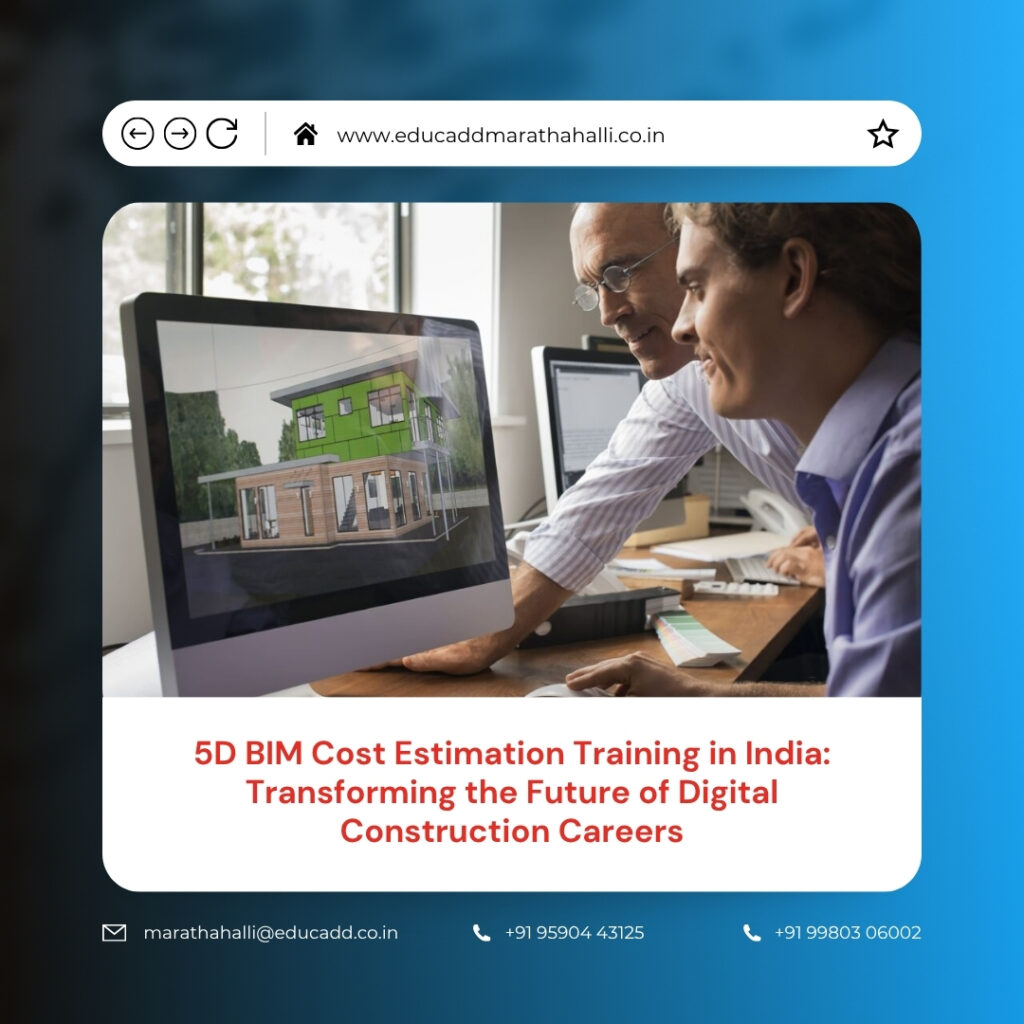
5D BIM Cost Estimation
5D BIM allows professionals to visualize cost impacts directly from a 3D model while linking scheduling and budgeting in real time. This integration improves decision-making and reduces errors during execution. As a result, trained professionals are becoming highly valuable in both domestic and global markets.
This blog explains how 5D BIM works, why it is important in India, what skills are required, career opportunities available, and how training can shape a successful future in the construction industry.
Understanding the Core Concept of 5D BIM in Construction
5D BIM is an advanced extension of Building Information Modeling that adds cost estimation to the 3D model along with scheduling data. The first three dimensions represent the physical structure of the building. The fourth dimension introduces time-based planning, while the fifth dimension integrates cost data into the model.
This system allows professionals to connect every building element with real-time financial data. When any design change occurs, the cost automatically updates within the model. This reduces manual effort and ensures high accuracy in budgeting.
Unlike traditional estimation methods, which depend on manual calculations and spreadsheets, 5D BIM provides a centralized digital environment. This helps all stakeholders collaborate efficiently and avoid miscommunication.
In modern construction, speed and precision are essential. Therefore, 5D BIM has become an industry standard for large-scale infrastructure projects such as highways, airports, metro systems, and commercial complexes.
Why India Is Becoming a Hub for 5D BIM Training
India’s construction industry is expanding rapidly due to urbanization, industrial development, and government-backed infrastructure projects. Smart city initiatives and large public infrastructure programs are increasing the demand for advanced planning technologies.
Because of this growth, companies are actively seeking professionals who understand digital construction systems. Traditional estimation skills alone are no longer sufficient to meet modern project requirements. Employers now prefer candidates trained in BIM workflows.
5D BIM cost estimation training in India is gaining popularity because it bridges the gap between academic learning and real industry needs. Training institutes provide practical exposure to real-time projects, which helps learners understand professional workflows.
Additionally, India is becoming a global outsourcing hub for BIM services. Many international firms hire Indian BIM professionals due to their technical expertise and cost-effective services. This creates strong global career opportunities for trained individuals.
Key Components of 5D BIM Cost Estimation Workflow
The 5D BIM workflow combines modeling, scheduling, and cost management into one integrated process. Each component plays a vital role in ensuring project success.
The first component is 3D modeling, which creates a digital representation of the building. This model includes architectural, structural, and MEP elements. The second component is 4D scheduling, which adds time-based sequencing to construction activities.
The third and most important component is cost estimation. Here, each building element is assigned a cost value based on materials, labor, and resources. The system automatically calculates total project expenses based on the model.
Key workflow advantages include:
- Automatic quantity extraction from digital models
- Real-time cost updates with design modifications
These features improve accuracy and reduce the chances of budget overruns. Moreover, they enhance coordination between design and construction teams.
Essential Software Used in 5D BIM Training Programs
Software knowledge is the backbone of BIM education. Without proper tools, it is impossible to understand real-world BIM workflows. Training institutes in India focus on globally accepted software used in construction industries.
Autodesk Revit is widely used for creating detailed 3D models. It allows users to build intelligent structures with embedded data. Navisworks helps in project coordination and clash detection, ensuring smooth execution.
Cost estimation tools such as CostX and Excel-based BIM integrations help in calculating project budgets accurately. Primavera and Microsoft Project are used for scheduling and time management.
These tools work together to form a complete BIM ecosystem. When professionals master these applications, they become capable of handling large-scale infrastructure projects with confidence and precision.
Skills Developed During 5D BIM Cost Estimation Training
A well-structured training program focuses on both technical and analytical skills. Students learn how to interpret construction drawings, create models, and extract quantity data.
They also gain knowledge of cost planning, budgeting techniques, and project scheduling systems. These skills help them understand how real construction projects operate from start to finish.
Important skills gained include:
- Quantity takeoff from BIM models
- Cost breakdown and estimation techniques
These skills are highly valued in the construction industry. They help professionals contribute effectively to project planning and execution while minimizing errors and delays.
Career Opportunities After Completing BIM Training in India
The demand for BIM professionals has increased significantly in recent years. Construction companies, architecture firms, and engineering consultancies are actively hiring trained individuals.
After completing 5D BIM training, candidates can apply for roles such as BIM Modeler, Quantity Surveyor, Cost Estimator, BIM Coordinator, and Project Planner. These roles exist in both private and government sectors.
International opportunities are also growing. Many Middle Eastern and European companies hire BIM professionals from India due to their strong technical knowledge and practical skills.
With the right training and experience, professionals can progress to senior roles such as BIM Manager or Project Lead. These positions offer higher salaries and leadership responsibilities in large infrastructure projects.
Importance of Cost Estimation Accuracy in Modern Projects
Cost estimation is one of the most critical aspects of construction management. Even minor errors can lead to financial losses and project delays. Therefore, accuracy is extremely important.
5D BIM improves estimation accuracy by linking every construction element directly to cost data. This reduces manual calculation errors and ensures consistent budgeting throughout the project lifecycle.
The system also updates costs automatically when design changes occur. This helps project managers make informed decisions quickly and avoid unexpected financial challenges.
As construction projects become more complex, accurate cost estimation becomes even more essential for successful project completion.
Role of BIM in Improving Project Collaboration
Construction projects involve multiple stakeholders, including architects, engineers, contractors, and clients. Effective communication between these teams is essential for smooth execution.
5D BIM creates a shared digital environment where all teams can access the same project data. This improves transparency and reduces communication gaps.
When everyone works on a unified model, misunderstandings decrease significantly. Teams can identify issues early and resolve them before construction begins.
This collaborative approach improves efficiency and ensures that projects stay within budget and timeline constraints.
Practical Exposure in BIM Training Institutes
Practical learning plays a crucial role in BIM education. Without real-world exposure, students may struggle to apply theoretical knowledge in professional environments.
Good training institutes provide live projects, case studies, and simulation-based learning. This helps students understand real construction challenges and solutions.
They also learn how to handle client requirements, manage project data, and coordinate between different teams. These experiences prepare them for real job responsibilities.
Institutes that focus on practical training produce highly skilled professionals who are job-ready from day one.
Global Demand for 5D BIM Professionals
The global construction industry is rapidly adopting BIM standards. Many countries now require BIM-based planning for public infrastructure projects.
Because of this, the demand for BIM professionals is increasing worldwide. Skilled individuals can work on international projects without relocating physically due to remote collaboration tools.
India has become a major center for BIM outsourcing services. Companies from the USA, UK, UAE, and Australia hire Indian professionals for cost-effective and high-quality BIM work.
This global demand creates strong career growth opportunities for trained professionals in the BIM industry.
Industries Actively Using 5D BIM Technology
5D BIM is widely used across multiple industries beyond traditional construction. Infrastructure development, transportation systems, healthcare facilities, and industrial plants all rely on BIM systems.
Highway and railway projects use BIM for planning and cost control. Hospitals use it for efficient space utilization and facility design. Smart city projects depend heavily on BIM for integrated infrastructure planning.
Industrial construction projects also use BIM for managing complex mechanical and structural systems. Even facility management companies use BIM after project completion for maintenance planning.
The widespread adoption of BIM across industries ensures long-term demand for skilled professionals.
Choosing the Right BIM Training Institute in India
Selecting the right institute is a key step in building a successful BIM career. Students should focus on curriculum quality, trainer experience, and practical exposure.
A good institute should offer updated software training and real-time project experience. Trainers with industry experience can provide better insights into professional workflows.
Placement support is another important factor. Institutes that offer job assistance help students transition smoothly into the workforce.
Certification recognition also matters. Industry-approved certifications improve credibility and increase job opportunities.
Future Scope of 5D BIM in Construction Industry
The future of BIM technology is highly promising. With advancements in artificial intelligence, cloud computing, and automation, BIM systems are becoming more intelligent and efficient.
Future construction projects will rely heavily on data-driven decision-making. BIM will play a central role in predicting costs, managing risks, and optimizing resources.
In India, government infrastructure projects will continue adopting BIM standards. This will increase the demand for trained professionals in the coming years.
As technology evolves, BIM professionals will need to upgrade their skills continuously to stay relevant in the industry.
Benefits of BIM Certification for Career Growth
Certification in 5D BIM adds strong value to a professional’s profile. It demonstrates technical expertise and practical knowledge to employers.
For students, certification improves job readiness and increases placement opportunities. For working professionals, it supports career advancement and salary growth.
Certified professionals often receive better opportunities in both national and international markets. Many companies prefer certified candidates for advanced BIM roles.
Therefore, BIM certification is a powerful step toward building a successful career in the construction industry.
Sustainability and Efficiency Through 5D BIM
Sustainability is becoming a major focus in modern construction practices. Builders are now aiming to reduce waste and improve energy efficiency.
5D BIM supports sustainable construction by providing accurate material calculations. This reduces unnecessary usage and minimizes waste generation.
It also helps in analyzing design efficiency before construction begins. This leads to better resource planning and environmentally responsible building practices.
As sustainability becomes a global priority, BIM professionals with green construction knowledge will be highly valued.
Conclusion
5D BIM cost estimation training in India is shaping the future of the construction industry. It combines technology, design, planning, and cost management into one powerful system that improves project efficiency.
As infrastructure development continues to grow, the need for skilled BIM professionals will also increase. This makes BIM training a valuable investment for students, engineers, and working professionals.
With the right skills, practical exposure, and certification, individuals can access excellent career opportunities in India and abroad. The construction industry is moving toward digital transformation, and BIM professionals will play a key role in this journey.
In the coming years, 5D BIM will become an essential part of every major construction project. Therefore, learning this technology today can create a strong foundation for a successful and future-ready career in the global construction sector.

